Nutrition
What to eat, what to drink, and what actually matters — separating real evidence from fitness-culture myths.
How Many Calories Do You Actually Need?
The starting point for any weight goal — a simple formula to estimate your own daily maintenance calories.
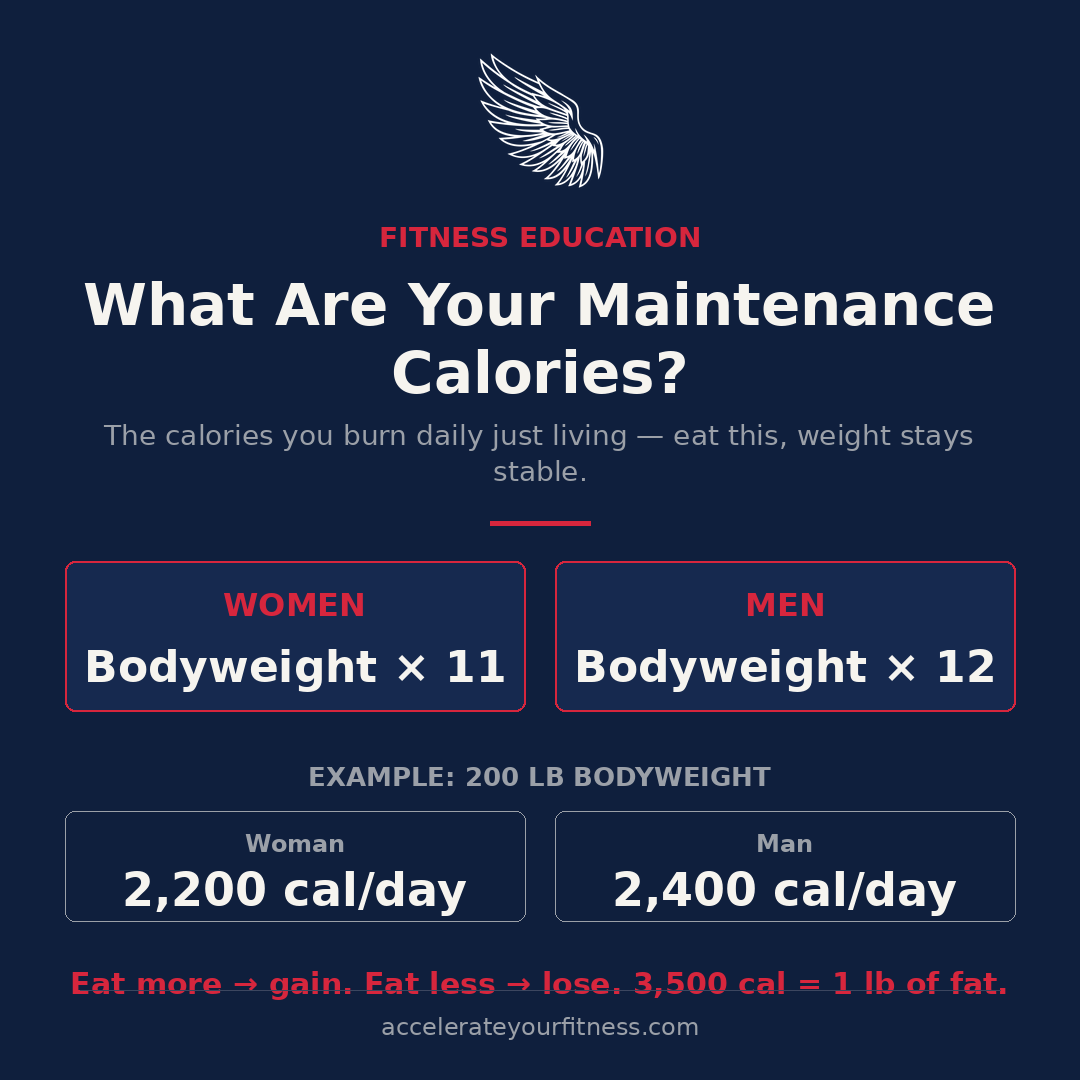
Your maintenance calories are the number you can eat daily without gaining or losing weight — the baseline every other goal builds from. A quick estimate: multiply your bodyweight by 11 for women or 12 for men. A 200 lb man, for example, lands around 2,400 calories a day; a 200 lb woman around 2,200.
Eat above that number consistently and you'll gain weight over time; eat below it and you'll lose. Since a pound of fat is roughly 3,500 calories, even a modest 150-calorie daily surplus adds up to about a pound gained every three weeks — which is exactly why small, consistent habits matter more than any single meal.
What Does the Research Actually Say About Diet Drinks?
The evidence has shifted in recent years — here's what's genuinely current, and how strong each finding actually is.
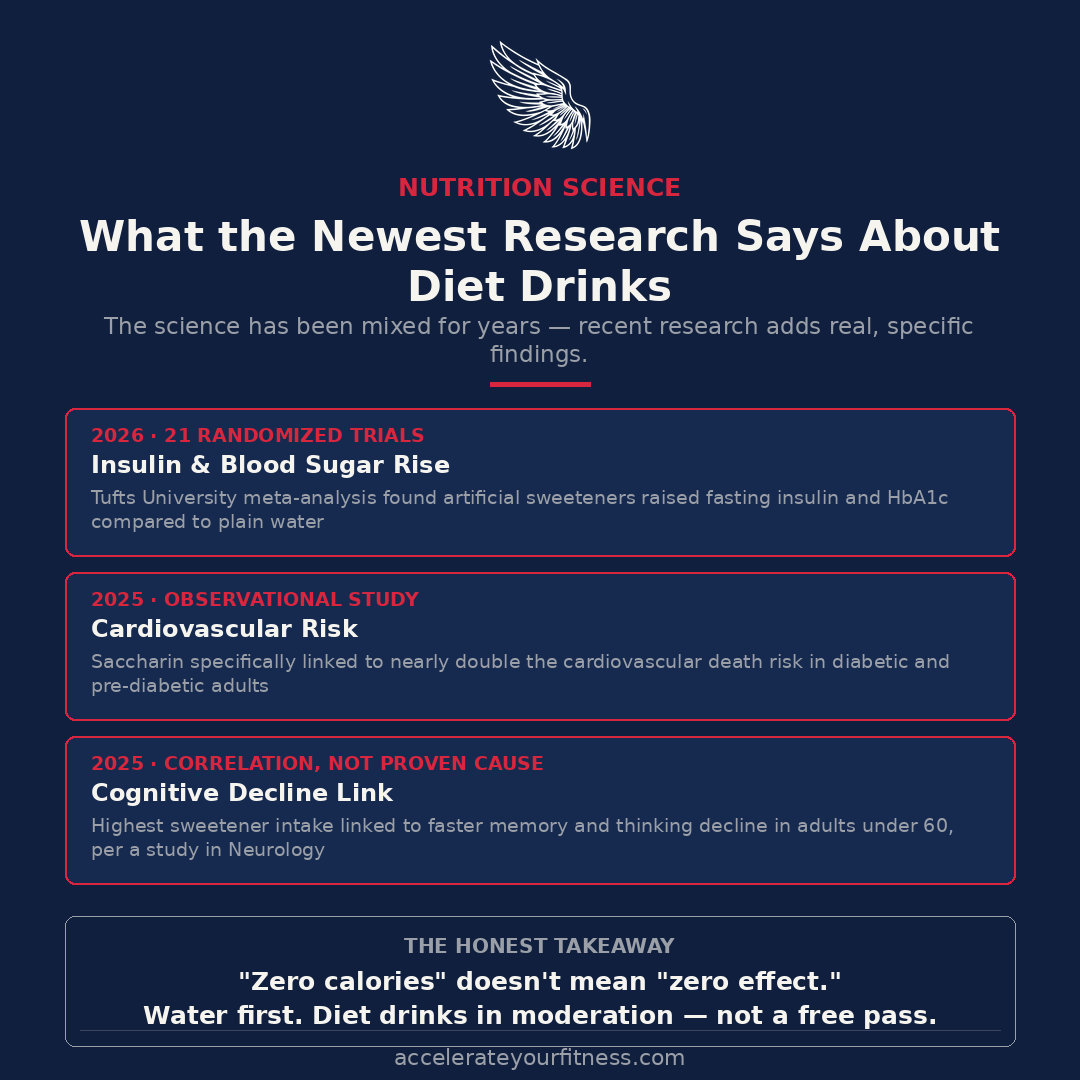
For years, the science on artificial sweeteners was genuinely mixed. But newer research has added real, specific findings worth knowing: a 2026 meta-analysis of 21 randomized controlled trials found artificial sweeteners raised both fasting insulin and blood sugar markers compared to water. Separately, one sweetener (saccharin) was linked to nearly double the cardiovascular death risk in diabetic and pre-diabetic adults, and a large study found a correlation — not proven cause — between high sweetener intake and faster cognitive decline in adults under 60.
"Zero calories" doesn't mean "zero effect." None of this makes diet drinks the enemy, but they're not the metabolically neutral swap they were once thought to be. Water first, and diet drinks in moderation — not a free pass.
What Should You Eat — and Take — Before a Workout?
Real food guidance, plus an honest look at which pre-workout supplements are actually backed by evidence — including non-caffeine options.
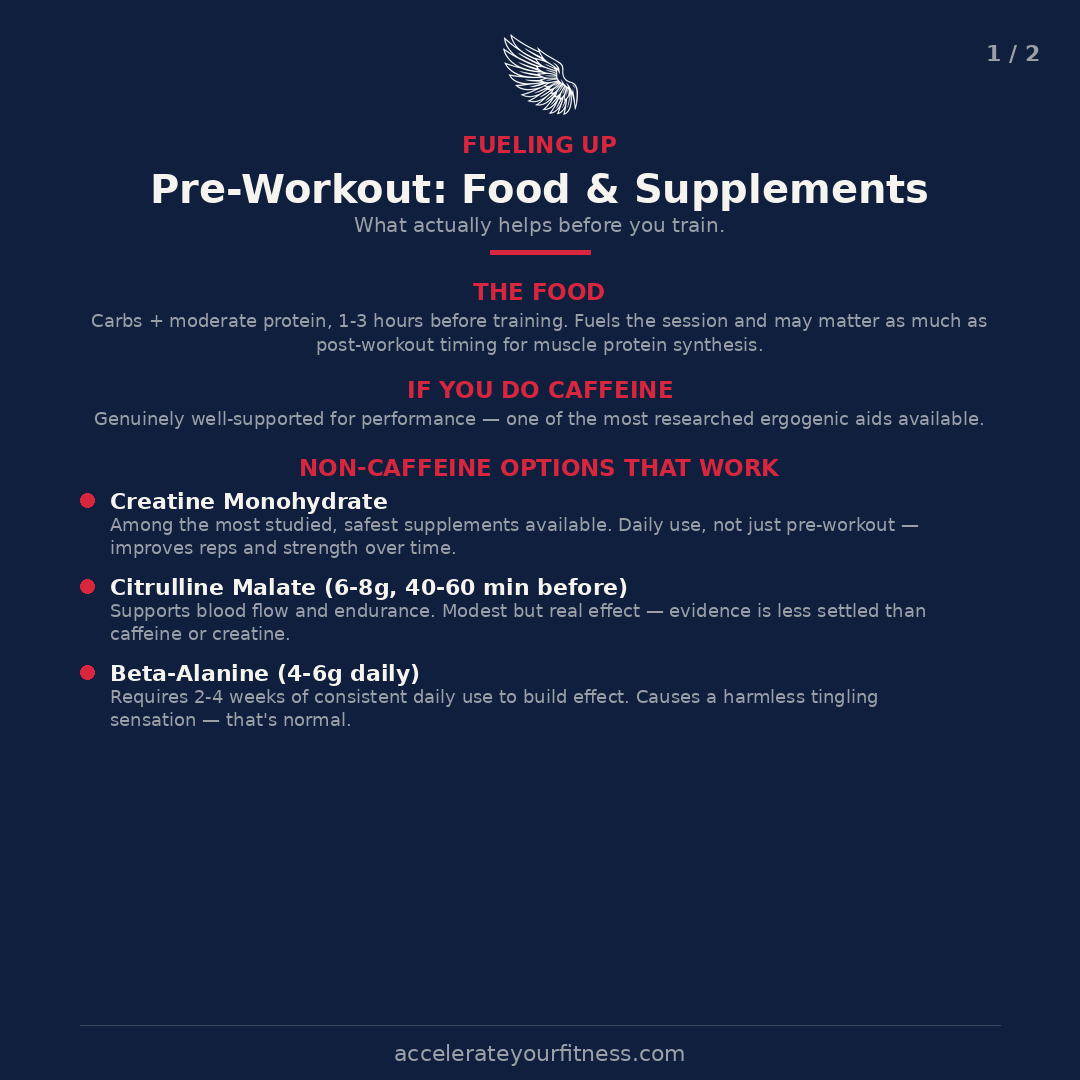
Food matters most: carbs plus moderate protein, 1–3 hours before training, fuels the session and may matter as much as post-workout timing for muscle protein synthesis. If you tolerate caffeine, it's genuinely one of the most well-researched performance aids available.
If you can't have caffeine, you're not out of options. Creatine monohydrate, citrulline malate (6–8g, 40–60 minutes before training), and beta-alanine (4–6g daily, taken consistently) all have real research support without any stimulant involved.
Does Post-Workout Timing Really Matter?
The "30-minute anabolic window" is one of the most repeated myths in fitness culture — here's what current research actually shows.
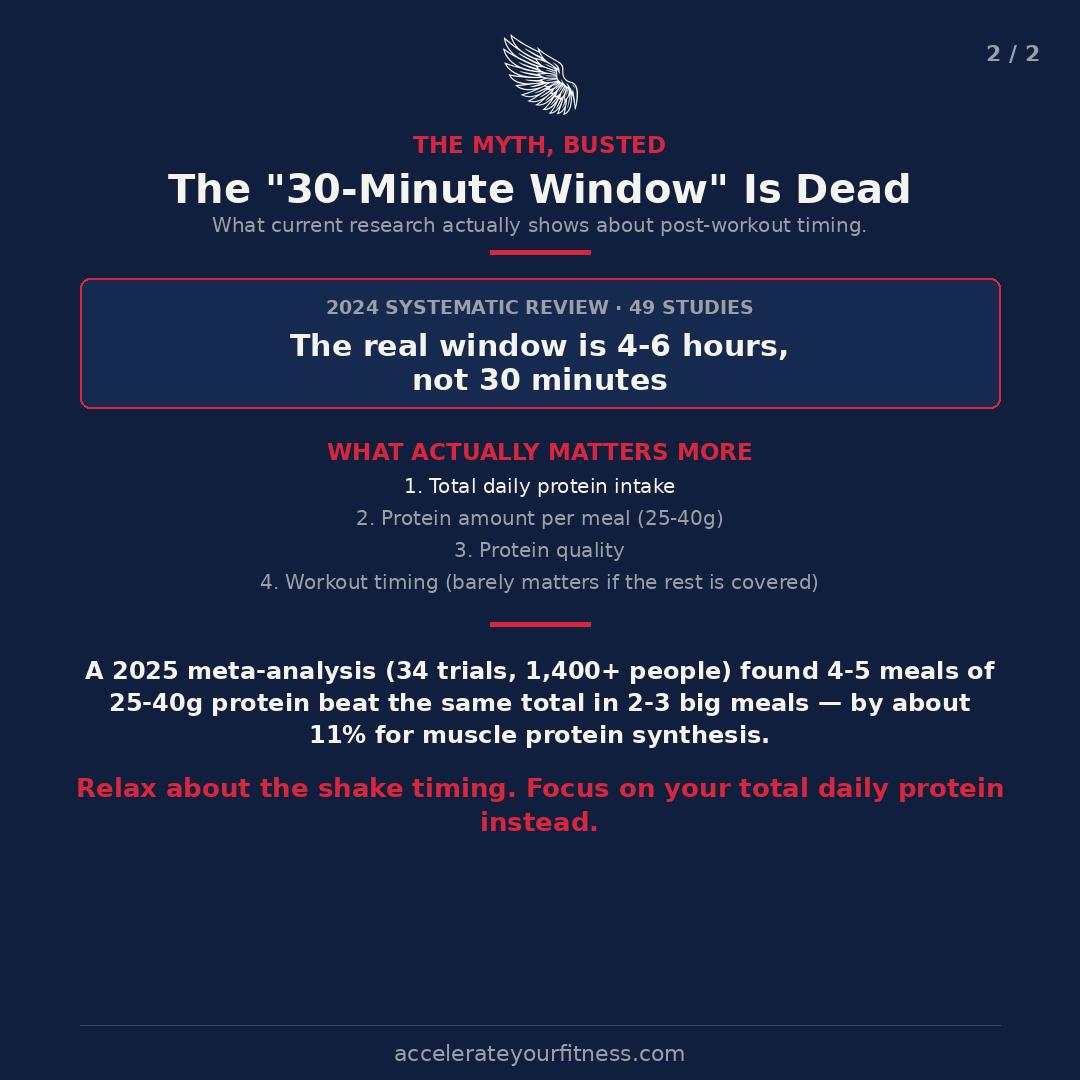
A 2024 systematic review of 49 studies found the real effective window for post-workout protein is 4–6 hours, not 30 minutes. A 2025 meta-analysis of 34 trials and over 1,400 participants found that workout timing ranked only fourth in importance — behind total daily protein intake, protein amount per meal, and protein quality.
Practically: distributing protein across 4–5 meals of 25–40g each outperformed the same total protein in 2–3 larger meals by about 11% for muscle protein synthesis. Relax about the shake stopwatch — focus on your total daily protein instead.
Finding a Protein Powder Your Stomach Can Actually Handle
If whey has never sat right with you, it might not be protein powder that's the problem — it might just be the source.
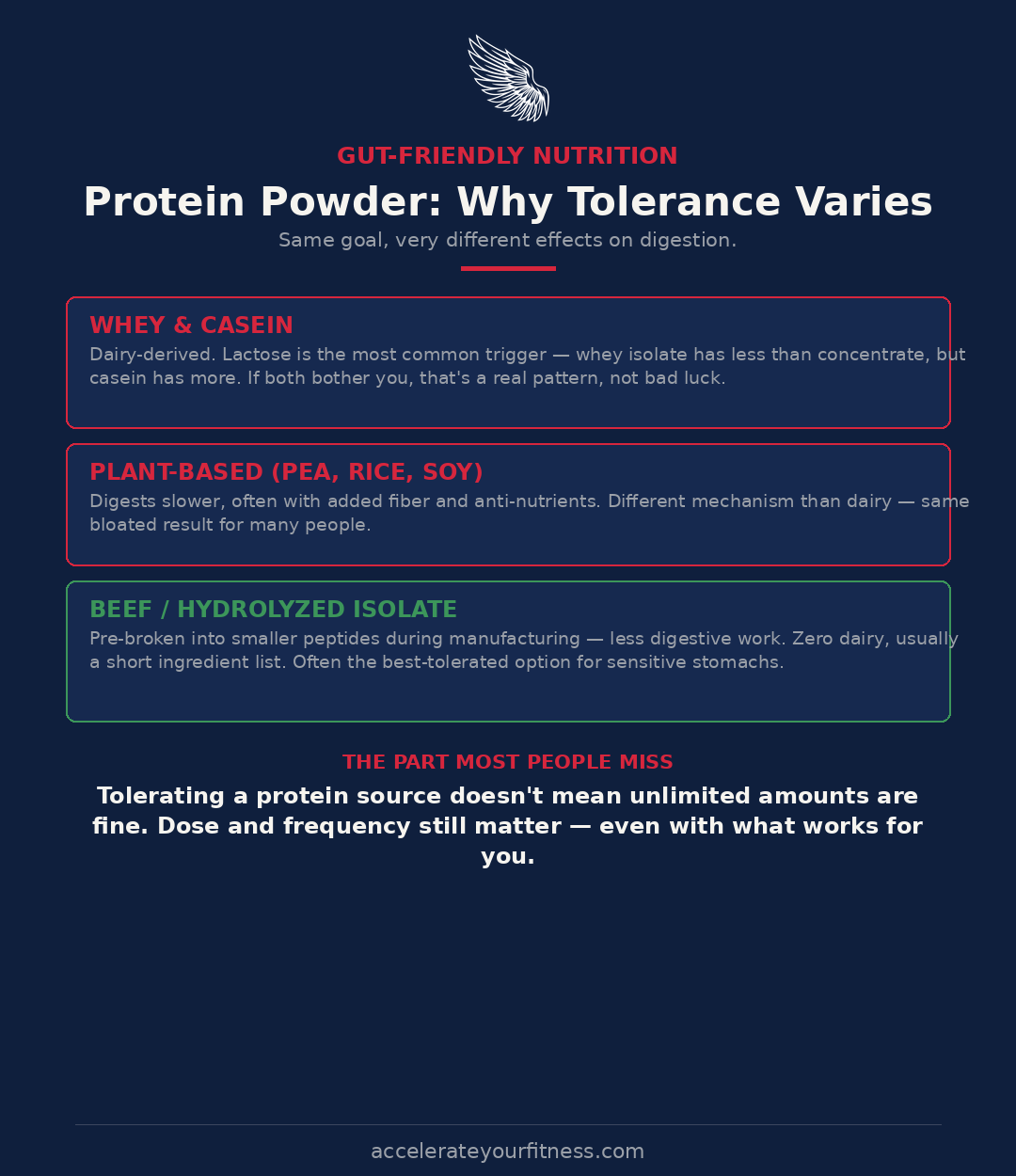
Whey and casein are both dairy-derived — lactose is the most common trigger for digestive upset, and if both bother you, that's a real, coherent pattern, not bad luck. Plant-based proteins digest more slowly and often carry added fiber that causes its own kind of bloating, a completely different mechanism with a similar result.
Beef and other hydrolyzed protein isolates are pre-broken into smaller peptides during manufacturing, meaning less digestive work, plus zero dairy and typically a much shorter ingredient list — often the best-tolerated option for sensitive stomachs. One thing worth knowing either way: tolerating a source doesn't mean unlimited amounts are fine. Dose and frequency still matter, even with what works for you.
How Much Water Do You Actually Need?
A simple formula works well for most people, right up until body weight gets very high.
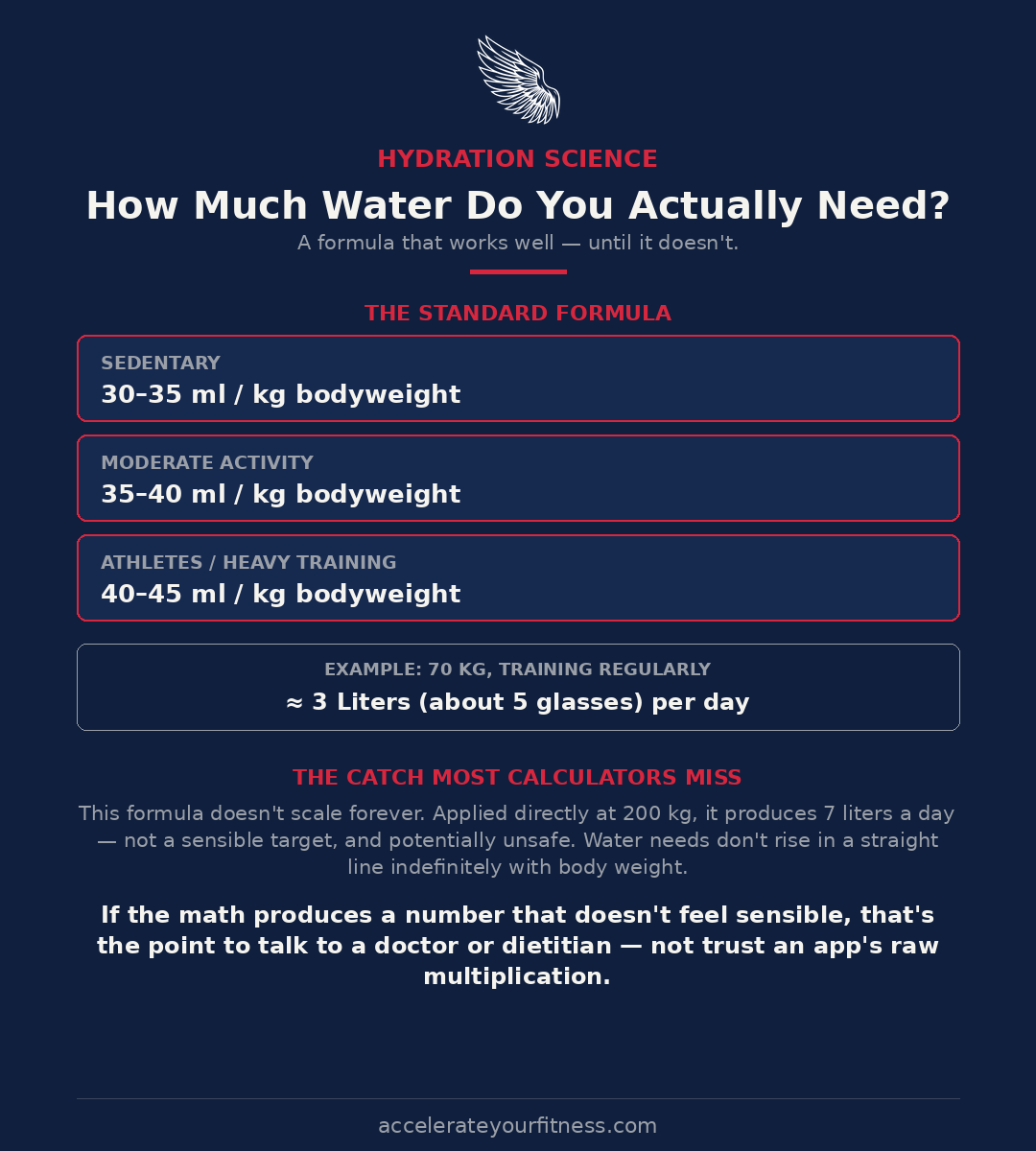
The standard guideline is 30–35 ml per kg of body weight at rest, 35–40 ml/kg with moderate activity, and 40–45 ml/kg for athletes and people training hard. For a 70 kg person training regularly, that works out to roughly 3 liters a day, or about five glasses.
The catch most calculators miss: the formula doesn't scale forever. Applied directly to someone at 200 kg, it produces about 7 liters a day, which isn't a sensible target for most people and can even be unsafe. Even the clinical literature is split on exactly how to adjust for very high body weights. If the math gives you a number that doesn't feel sensible, that's the point to talk with a doctor or dietitian rather than trusting a calculator's raw multiplication.
Which Meal Plan Is Right for You?
Three different approaches, built for three different starting points.
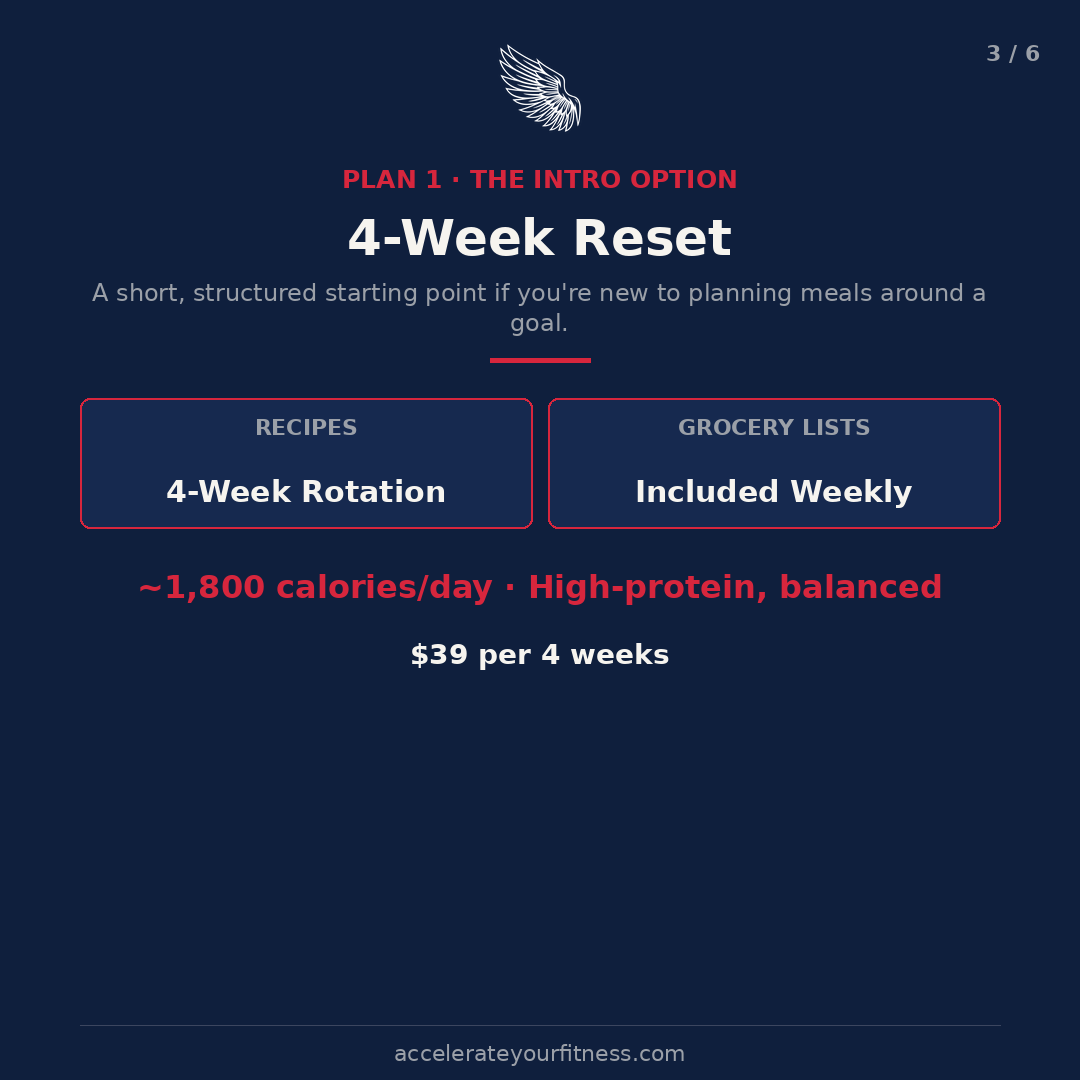

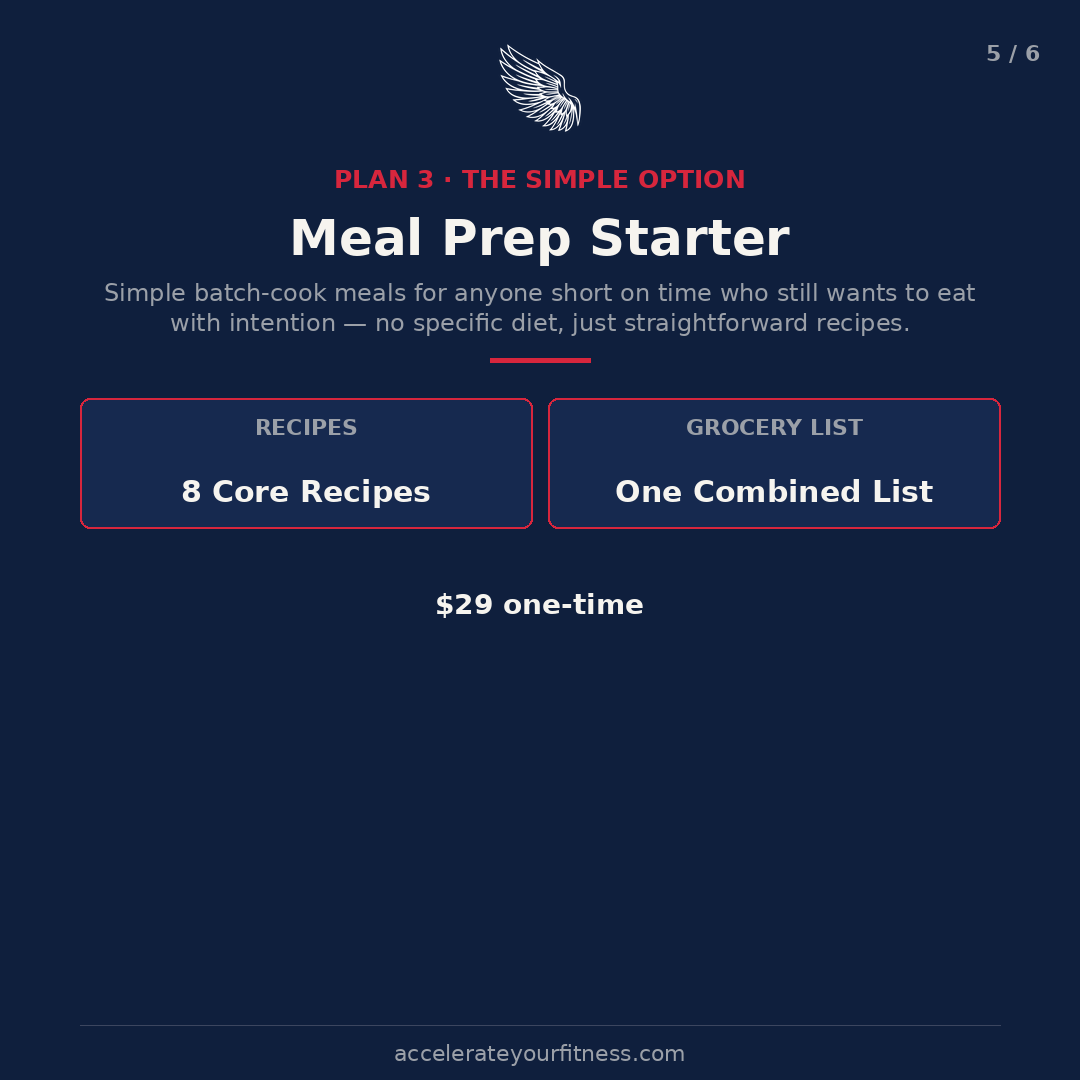
A structured meal plan removes the daily "what's for dinner" decision entirely, replacing it with real consistency instead of relying on willpower alone. 4-Week Reset is a high-protein, balanced intro option for anyone new to structured eating. 8-Week Steady Loss takes a Mediterranean-style approach built for sustainable, long-term progress rather than a quick, hard cut. Meal Prep Starter offers 8 core batch-cook recipes for anyone short on time who still wants to eat with intention.
All three include real recipes and grocery lists, delivered through the LVLUP app. See full plan details and pricing →
Posture & Injury Prevention
How everyday habits — sitting, phone use, skipping stretches — actually affect your body over time.
Why Sitting All Day Causes Low Back Pain
It's not just posture — it's a specific, three-part muscle pattern with a real clinical name.
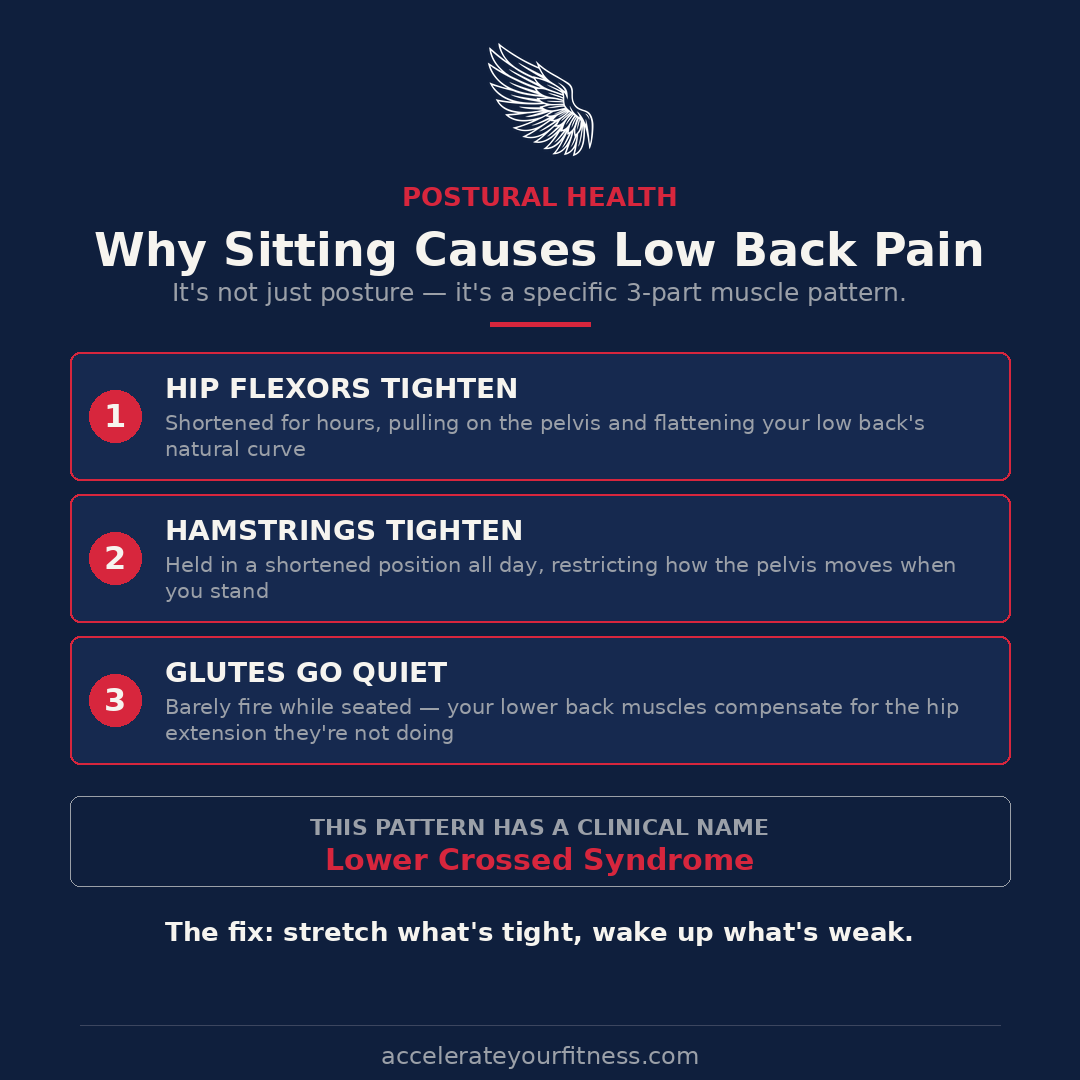
Prolonged sitting reshapes how your muscles work in a predictable pattern: hip flexors tighten from hours in a shortened position, pulling on the pelvis and flattening your low back's natural curve. Hamstrings tighten too, restricting how the pelvis moves once you stand. Meanwhile, your glutes go quiet — the muscle that should power hip extension barely fires while seated, so your lower back muscles compensate instead.
This pattern has a real clinical name: lower crossed syndrome. It's genuinely common, not a personal failing — and the fix is straightforward: stretch what's tight, and wake up what's weak.
The Real Impact of "Text Neck" on Your Spine
What looking down at your phone actually does to your neck, quantified.
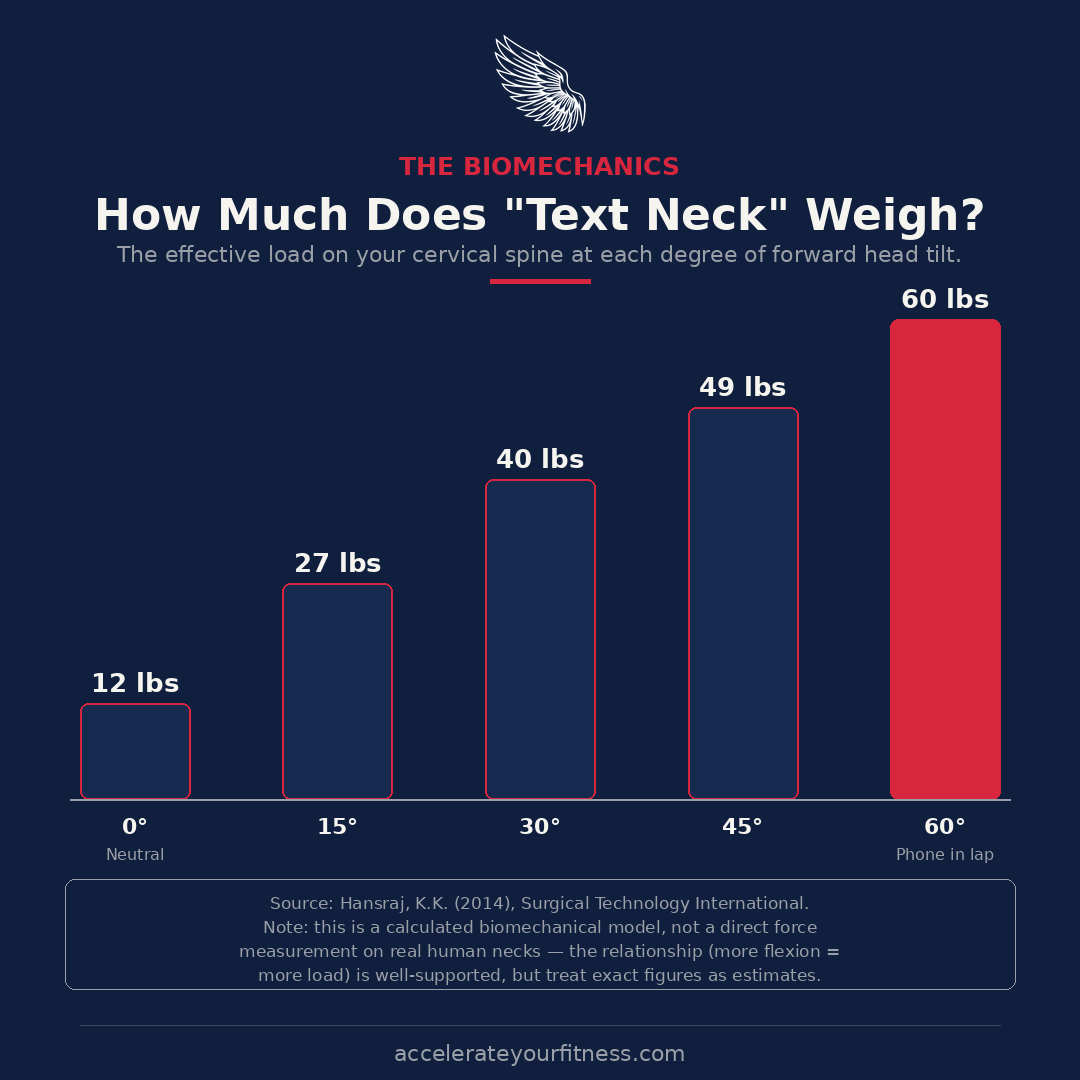
At just 15 degrees of forward head tilt — a normal phone-checking angle — the effective load on your cervical spine roughly doubles to around 27 lbs. At 60 degrees, it's closer to 60 lbs. This is a calculated biomechanical estimate, not a direct force measurement, but the underlying relationship — more flexion means meaningfully more load — is well supported.
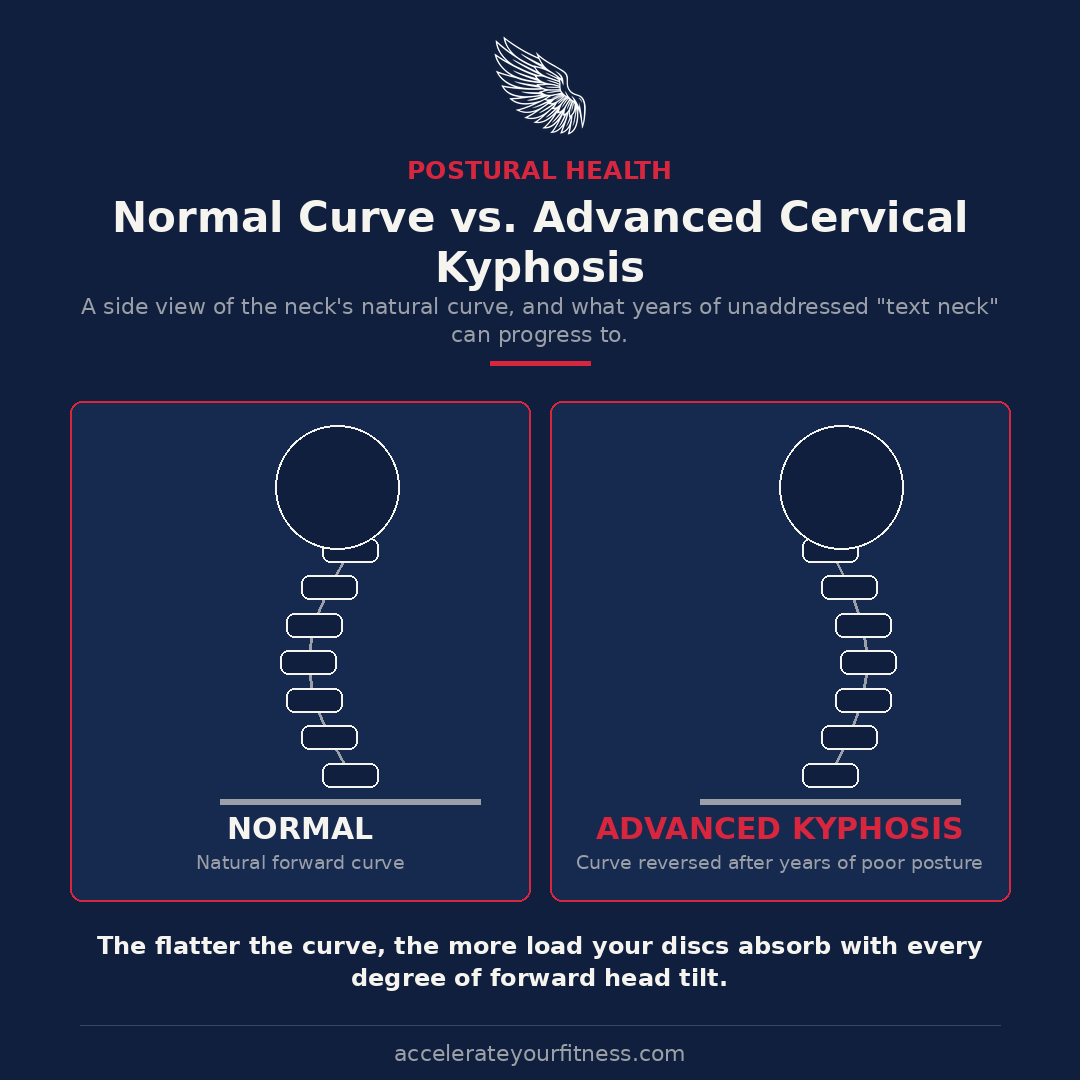
Chronic forward head posture can flatten the neck's natural curve over time, and research links that loss of curve to accelerated disc degeneration. The fix isn't avoiding your phone entirely — it's bringing the device up toward eye level instead of dropping your head to meet it, and building in real breaks from that flexed position throughout the day.
Static vs. Dynamic Stretching: When to Use Each
Using the right one at the right time genuinely matters — per ACSM guidelines.
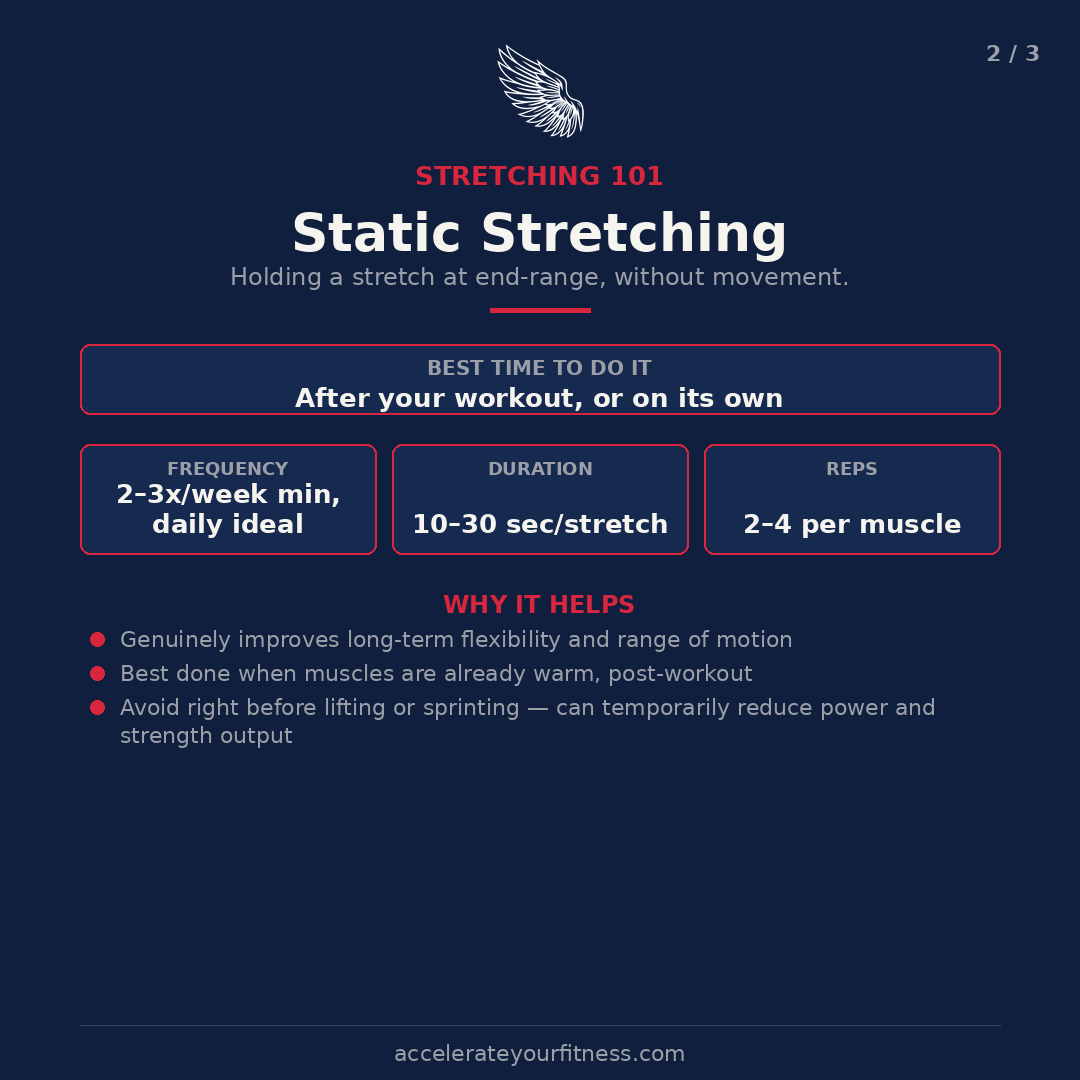
Static stretching — holding a stretch at end-range without movement — is best done after your workout, or on its own. Hold each stretch 10–30 seconds, 2–4 reps per muscle. Doing this right before lifting or sprinting can temporarily reduce power and strength output.
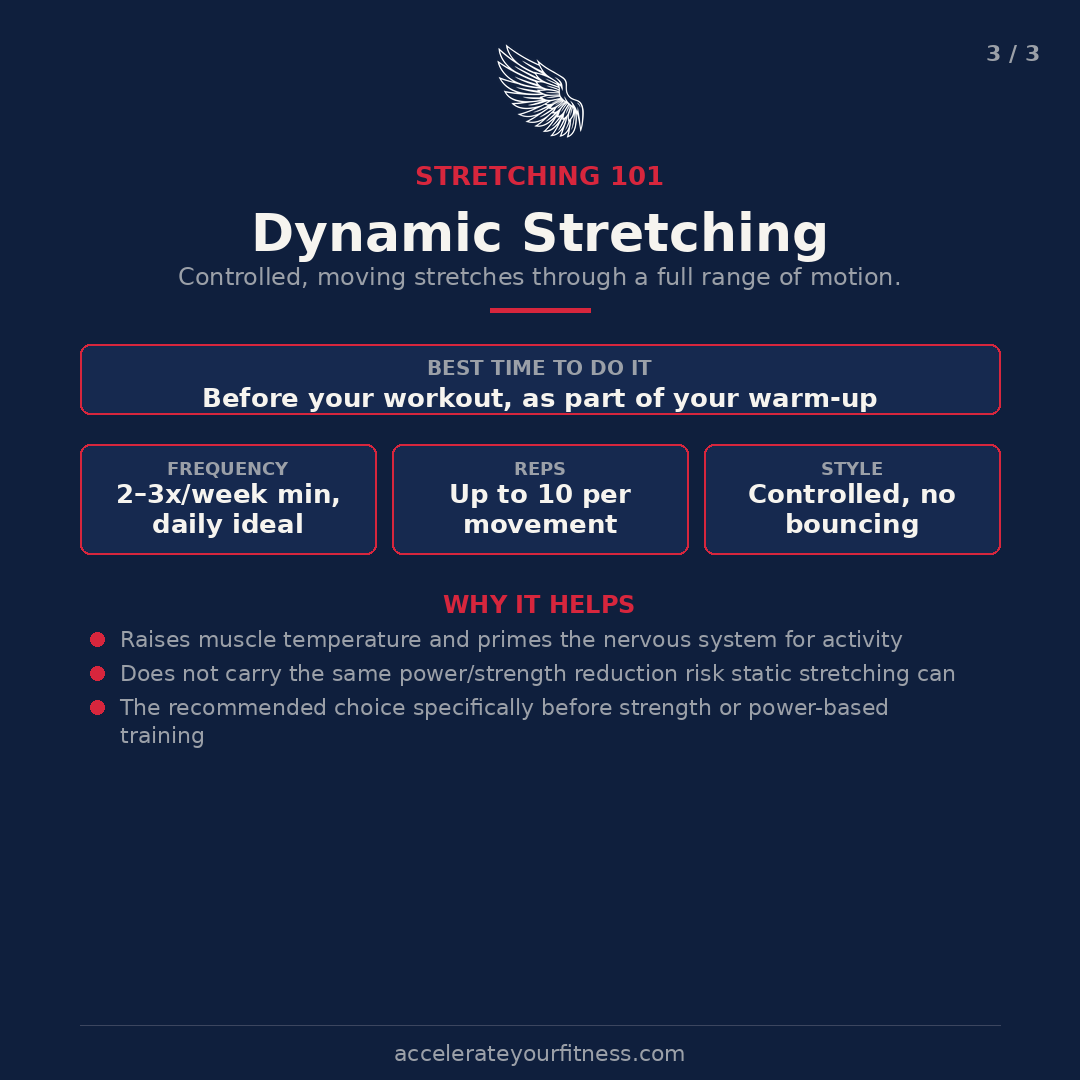
Dynamic stretching — controlled, moving stretches through a full range of motion — is the better choice before your workout, as part of a warm-up. It raises muscle temperature and primes the nervous system for activity without that same power-reduction tradeoff. Both should be done 2–3x per week minimum for major muscle groups, with daily stretching giving the best results.
Training & Fitness Guidance
How to actually structure your training — and how to make it a habit that sticks.
Reps, Sets & Your Goal
The rep range you train in determines the adaptation you actually get.
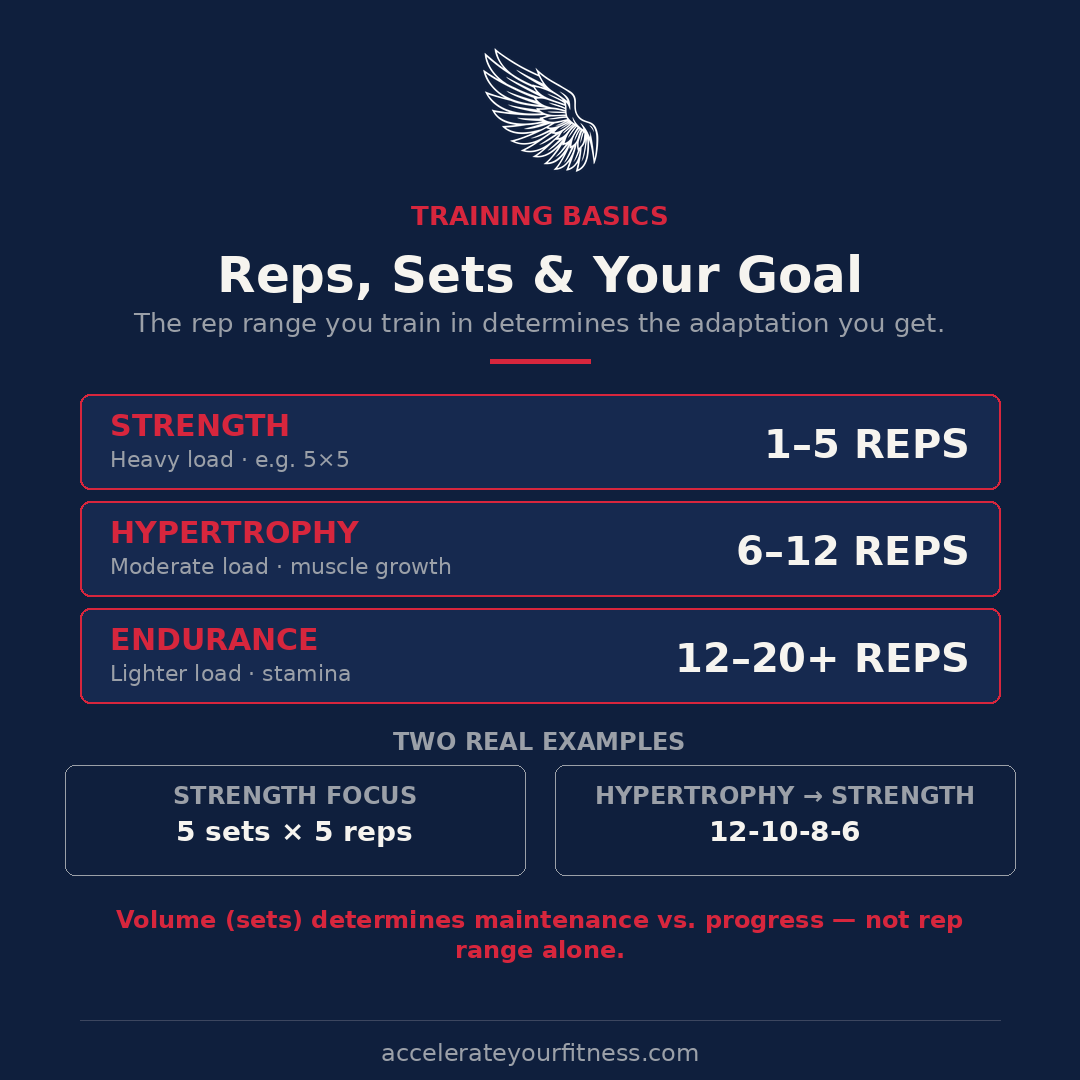
1–5 reps (heavy load) trains primarily for strength. 6–12 reps (moderate load) trains primarily for hypertrophy, or muscle growth. 12–20+ reps (lighter load) trains primarily for muscular endurance.
A classic pure-strength approach is 5 sets of 5 reps at a heavy weight throughout. A hypertrophy-to-strength blend uses a pyramid scheme like 12-10-8-6, adding weight as reps drop each set. One key distinction: how many total sets you do (your volume) is really what separates maintaining your current level from making new progress — not the rep range alone.
What Is Periodization, and Why Does It Matter?
Structured, planned changes to your program — not random variation.
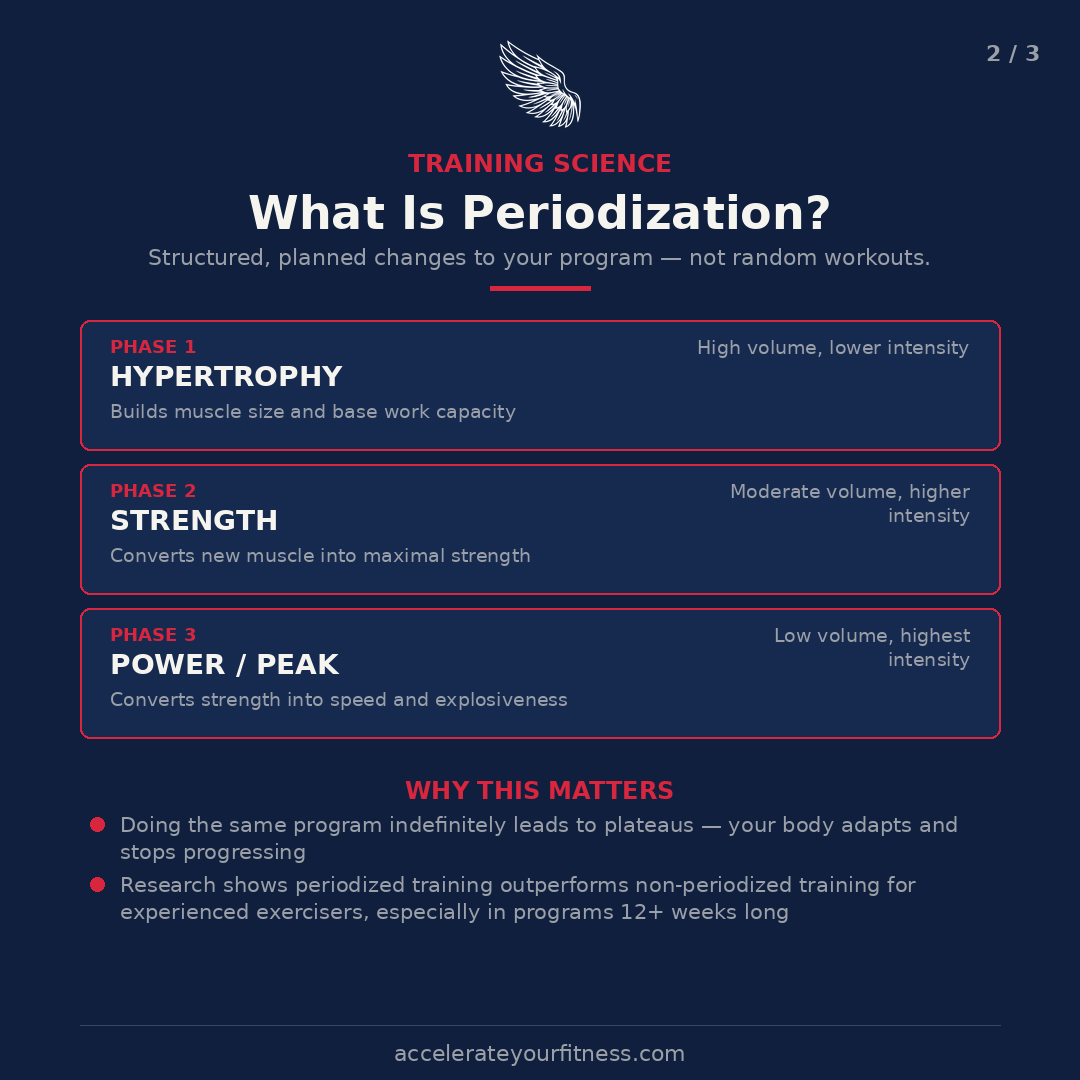
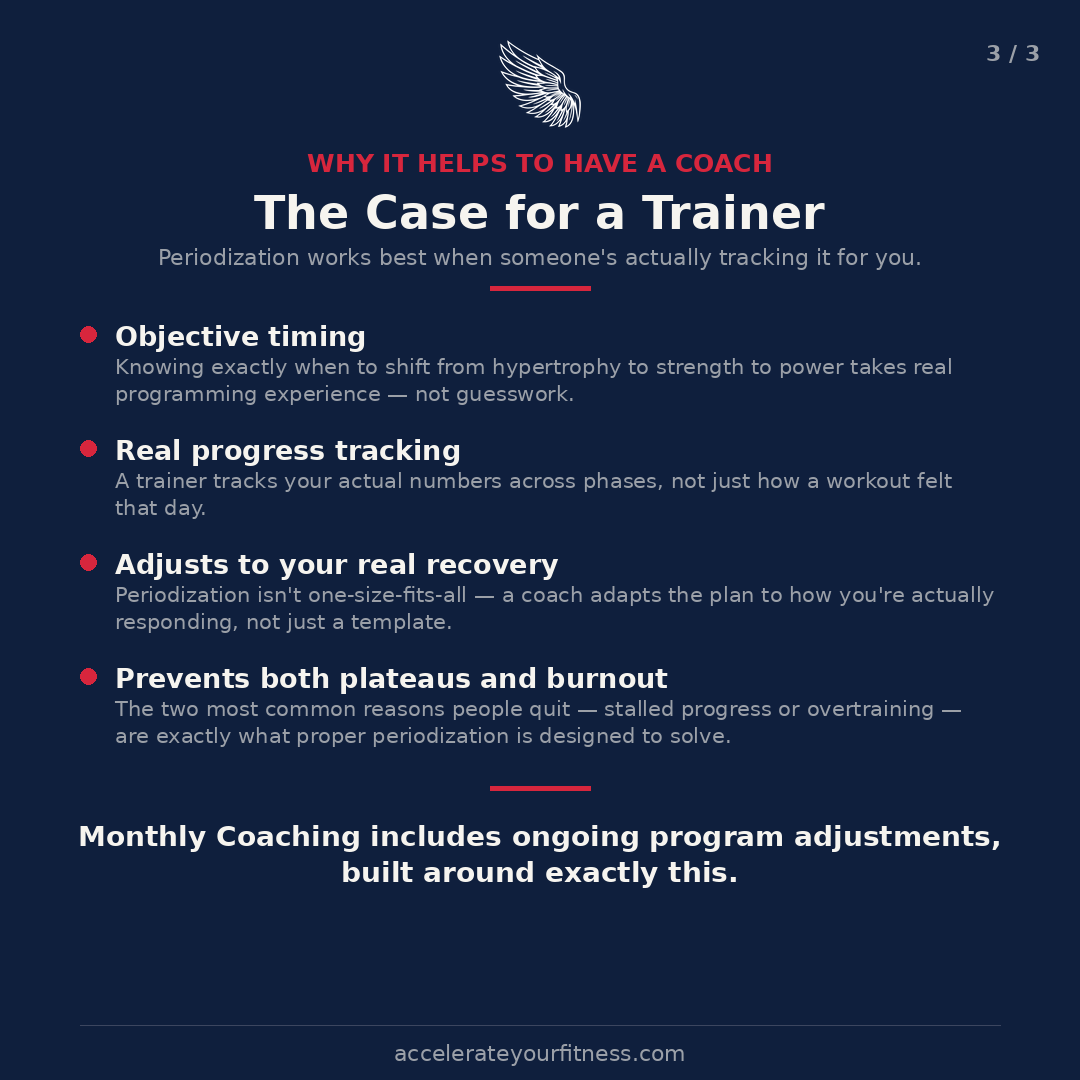
The classic three-phase approach: Hypertrophy (high volume, lower intensity) builds muscle size and base work capacity. Strength (moderate volume, higher intensity) converts that new muscle into maximal strength. Power/Peak (low volume, highest intensity) converts strength into speed and explosiveness.
Doing the same program indefinitely leads to plateaus — your body adapts to a fixed stimulus and stops progressing. Research shows periodized training outperforms non-periodized training for experienced exercisers, especially in programs 12+ weeks long. Knowing exactly when to shift phases, and tracking real numbers rather than just how a workout felt, is exactly where a coach earns their value.
Why Most People Quit — and How to Build a Habit That Lasts
It usually isn't lack of willpower. It's how they start.
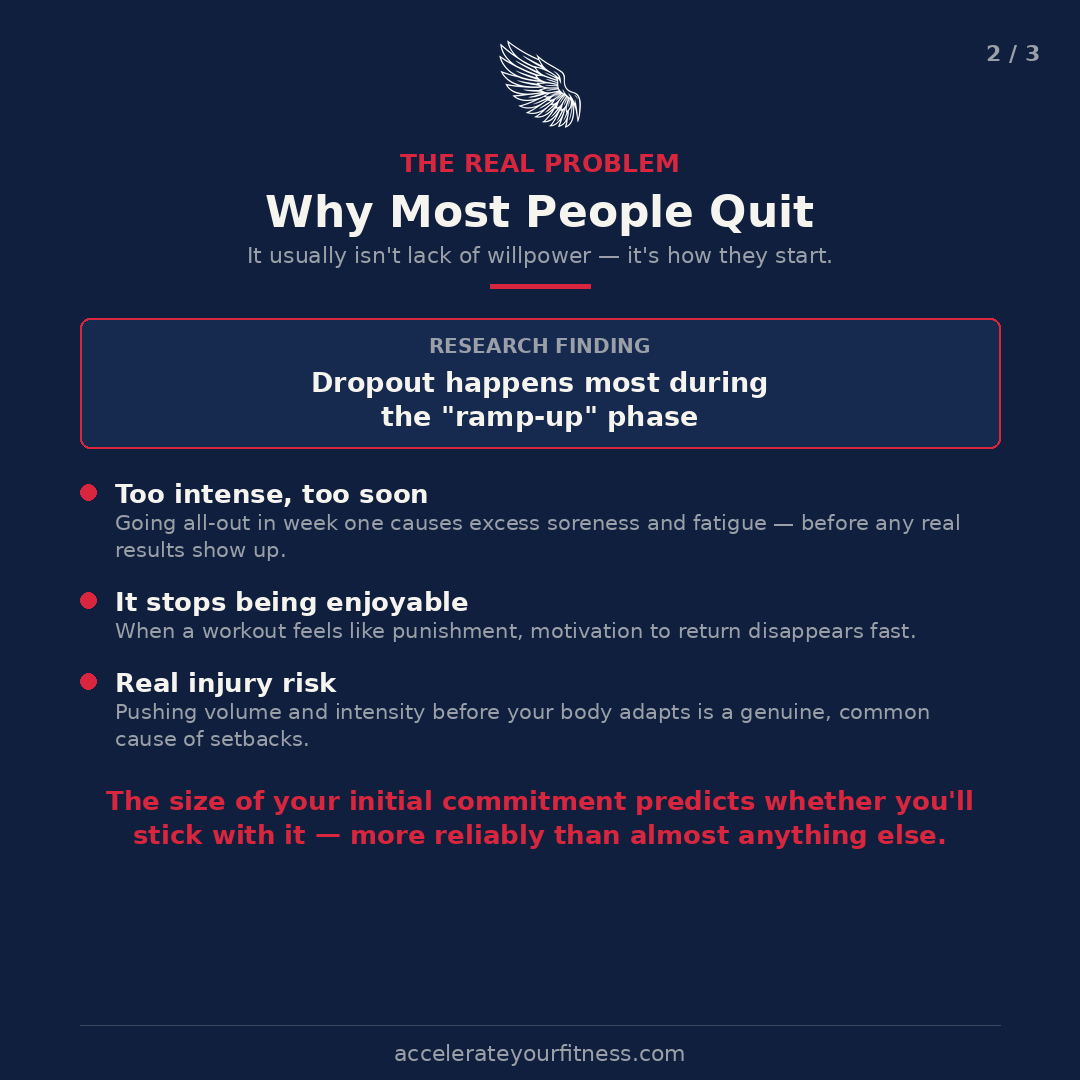
Research shows dropout happens most often during the "ramp-up" phase — while intensity is still increasing, before people even reach their full program. Going too hard, too soon leads to excess soreness, real injury risk, and a workout that starts feeling like punishment. In fact, the size of your initial commitment predicts whether you'll stick with it more reliably than almost any other variable.
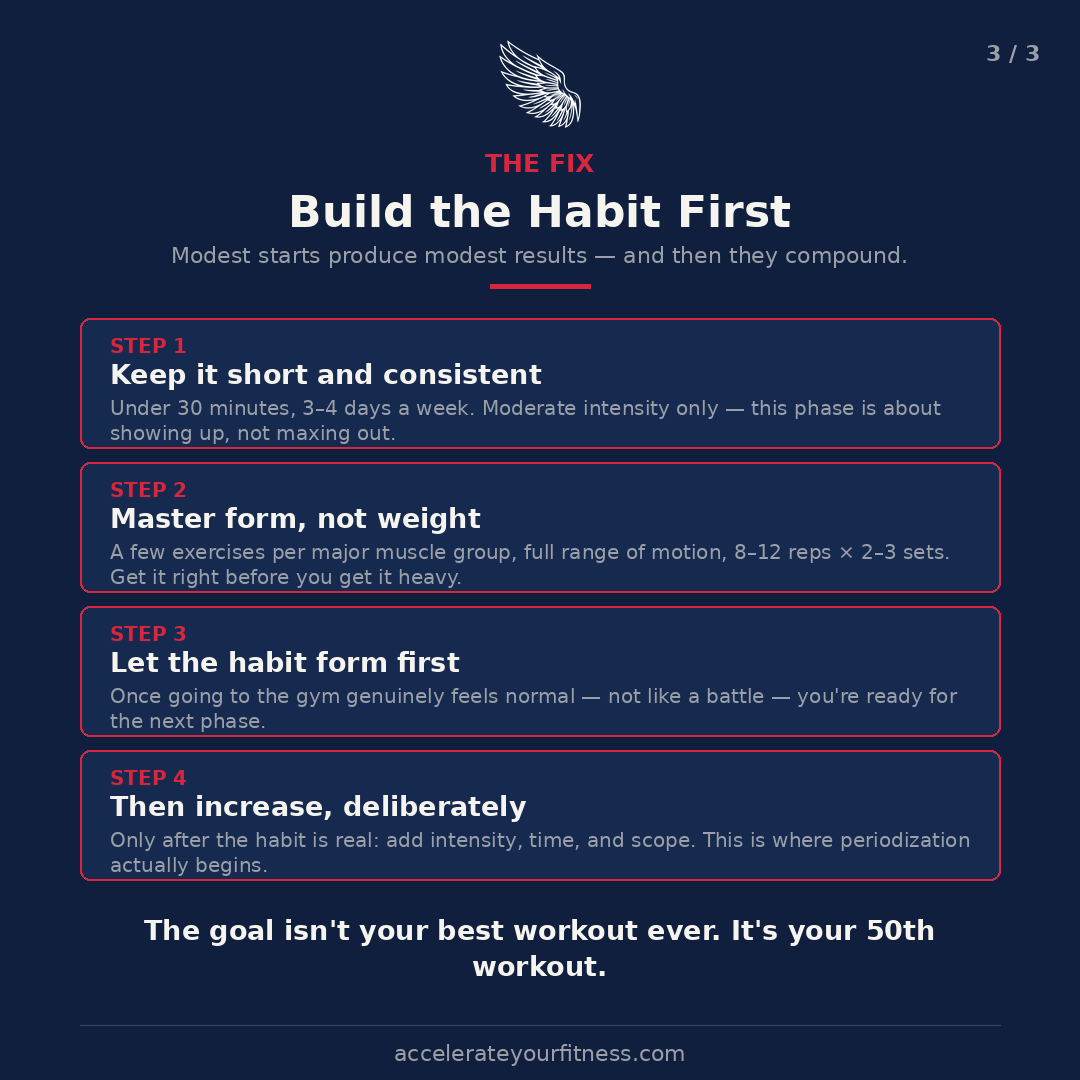
The fix: build the habit before you build the intensity. Start with sessions under 30 minutes, 3–4 days a week, moderate intensity only. Master form and full range of motion with a few exercises per major muscle group — 8–12 reps × 2–3 sets — before adding weight. Only once the habit genuinely feels normal, not like a battle, is it time to increase intensity, time, and scope.
Everyday Activities That Count as Real Exercise
You don't need a gym to hit your activity goals.
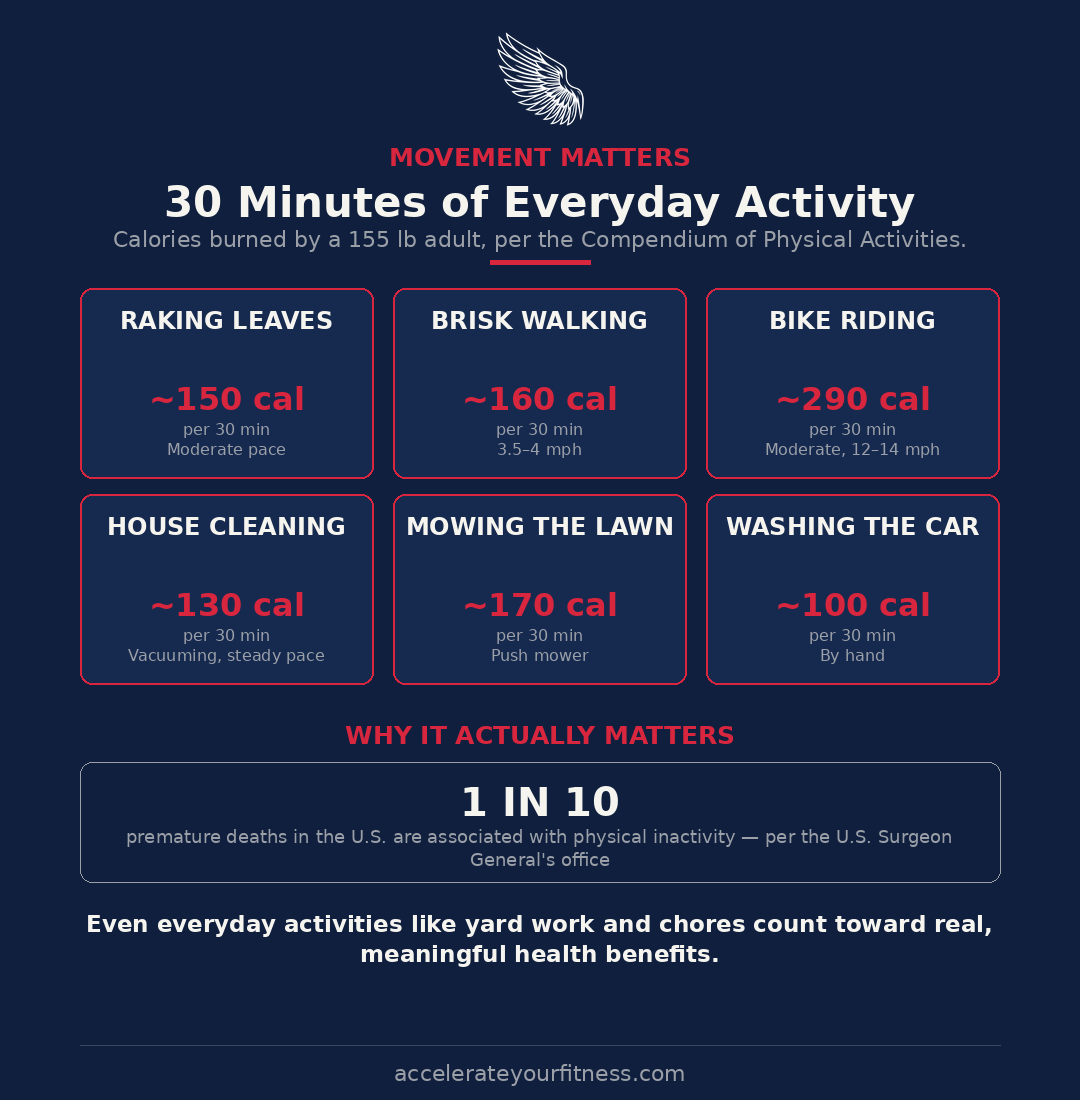
Current health guidelines recommend a baseline of 150 minutes of moderate activity per week — and everyday tasks genuinely count toward that total. Raking leaves burns roughly 150 calories per 30 minutes; brisk walking around 160; biking around 290; mowing the lawn around 170; even vacuuming burns roughly 130.
Why this is worth taking seriously: 1 in 10 premature deaths in the U.S. are associated with physical inactivity, per the Surgeon General's office. Consistent movement, in whatever form actually fits your life, has a genuine, measurable impact — and the benefit keeps increasing up to about 300 minutes a week, not stopping at the 150-minute baseline.
Cardio or Resistance Training: Which Is Better for Fat Loss?
They're not competing for the same job.
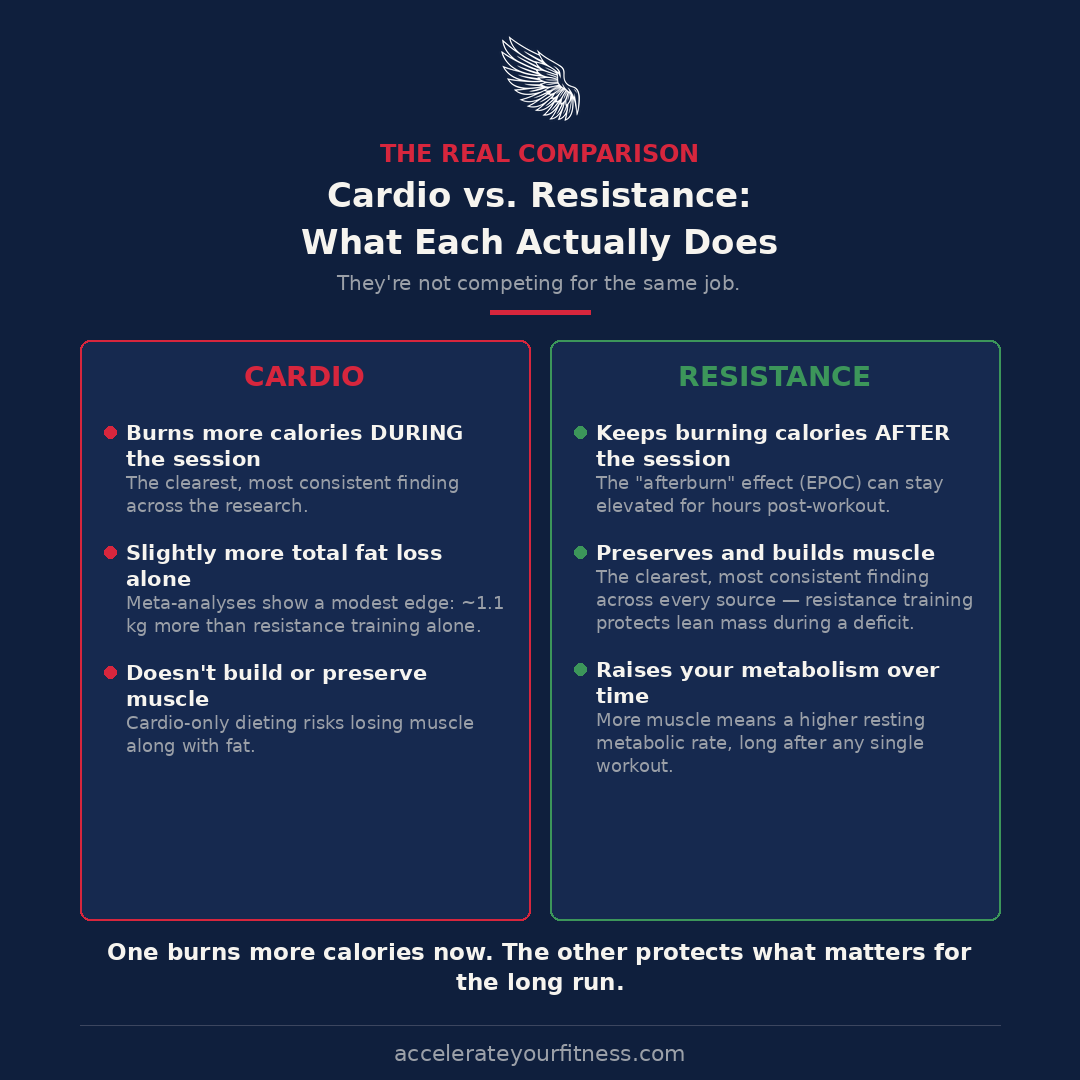
Cardio burns more calories during the session itself, and meta-analyses show a modest edge in total fat loss when it's used alone, about 1.1 kg more than resistance training alone. But it doesn't build or preserve muscle, so cardio-only dieting risks losing muscle along with fat.
Resistance training keeps burning calories after the session through the "afterburn" effect, and it's the clearest, most consistent finding in the research for protecting and building lean mass during a calorie deficit. More muscle also raises your resting metabolic rate over time.
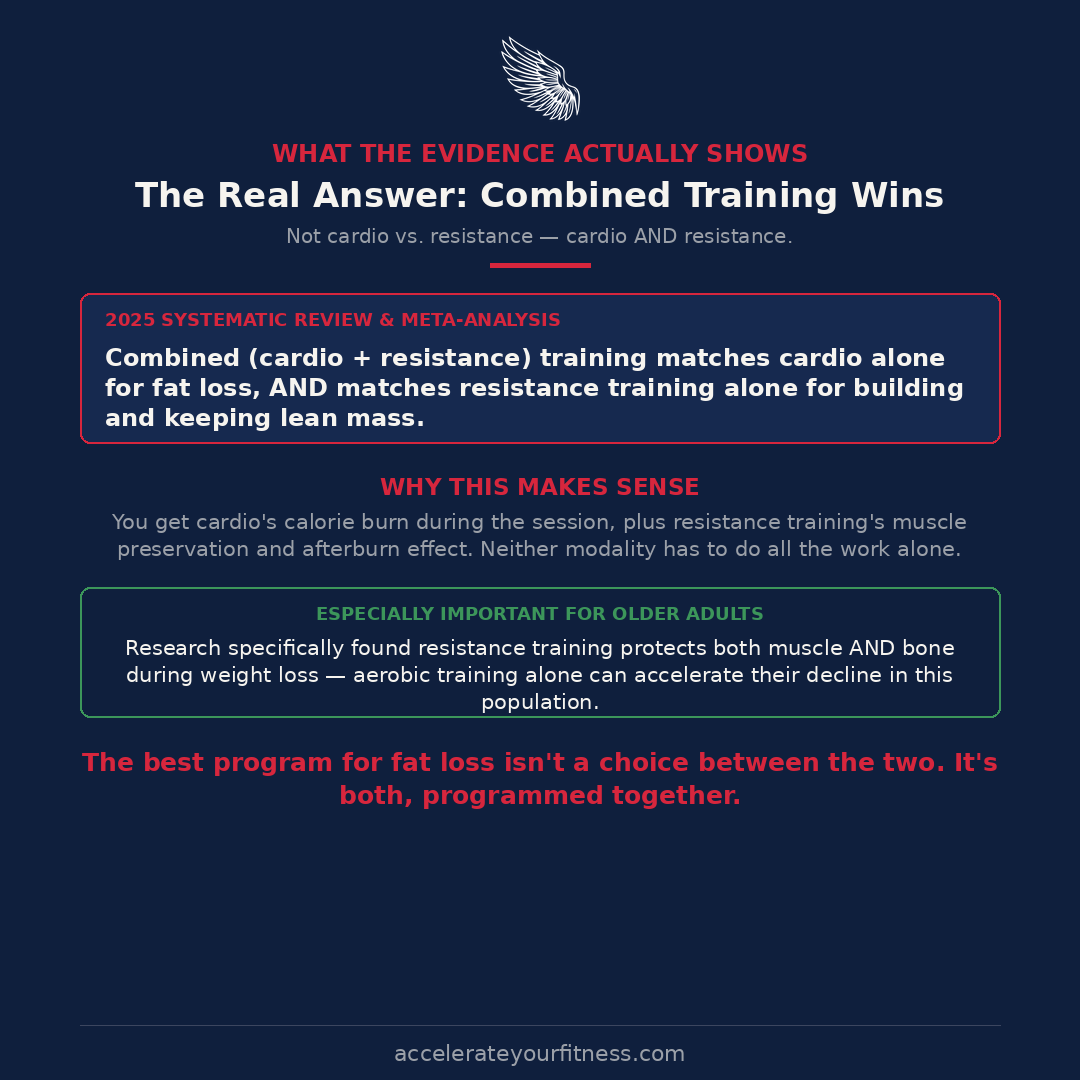
A 2025 systematic review and meta-analysis found that combined training matches cardio for fat loss and matches resistance training for keeping lean mass. Neither has to do all the work alone. This matters even more for older adults, where resistance training protects both muscle and bone during weight loss while aerobic training alone can accelerate their decline.
Does Cortisol Really Stop Weight Loss?
A real mechanism, but more nuanced than most fitness content suggests.
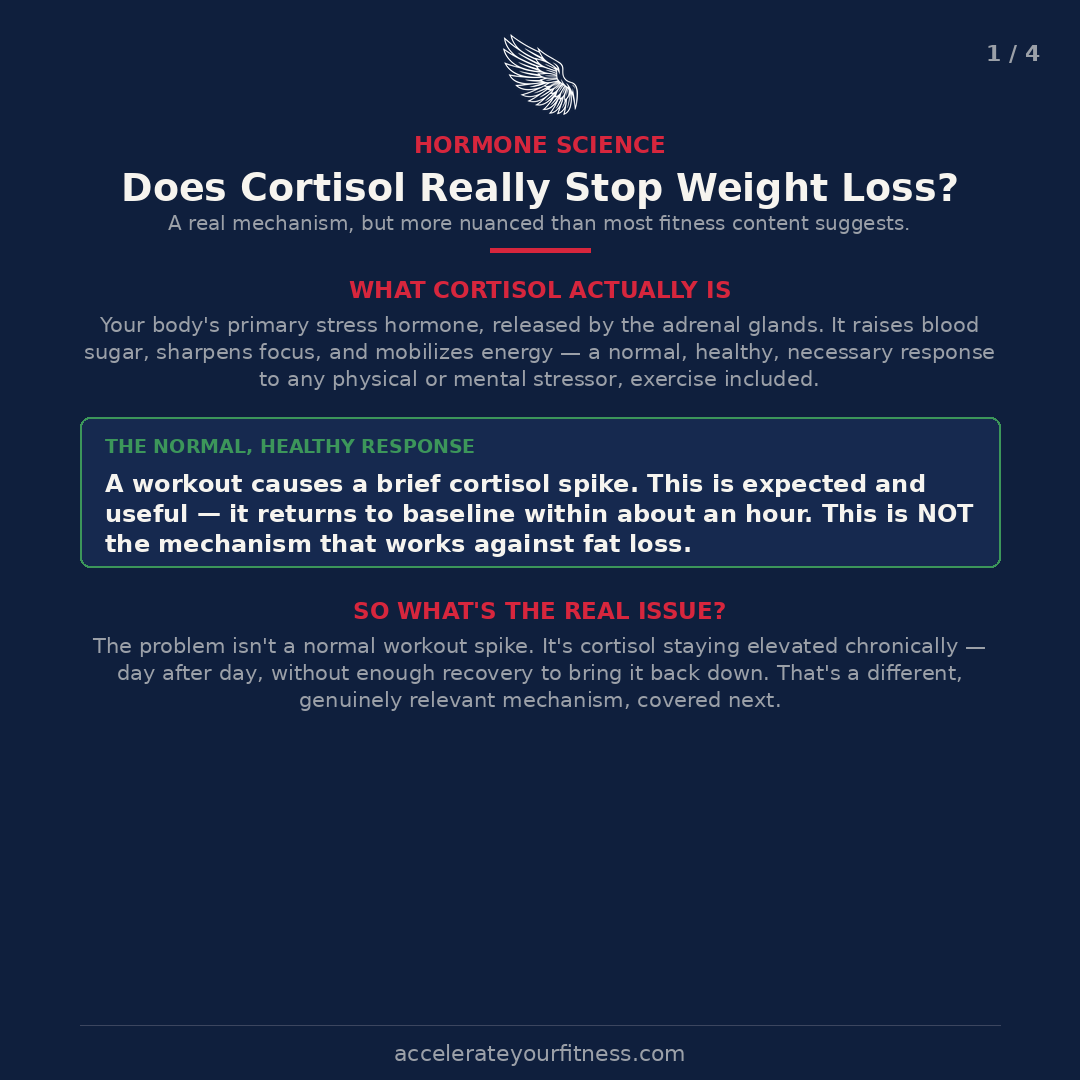
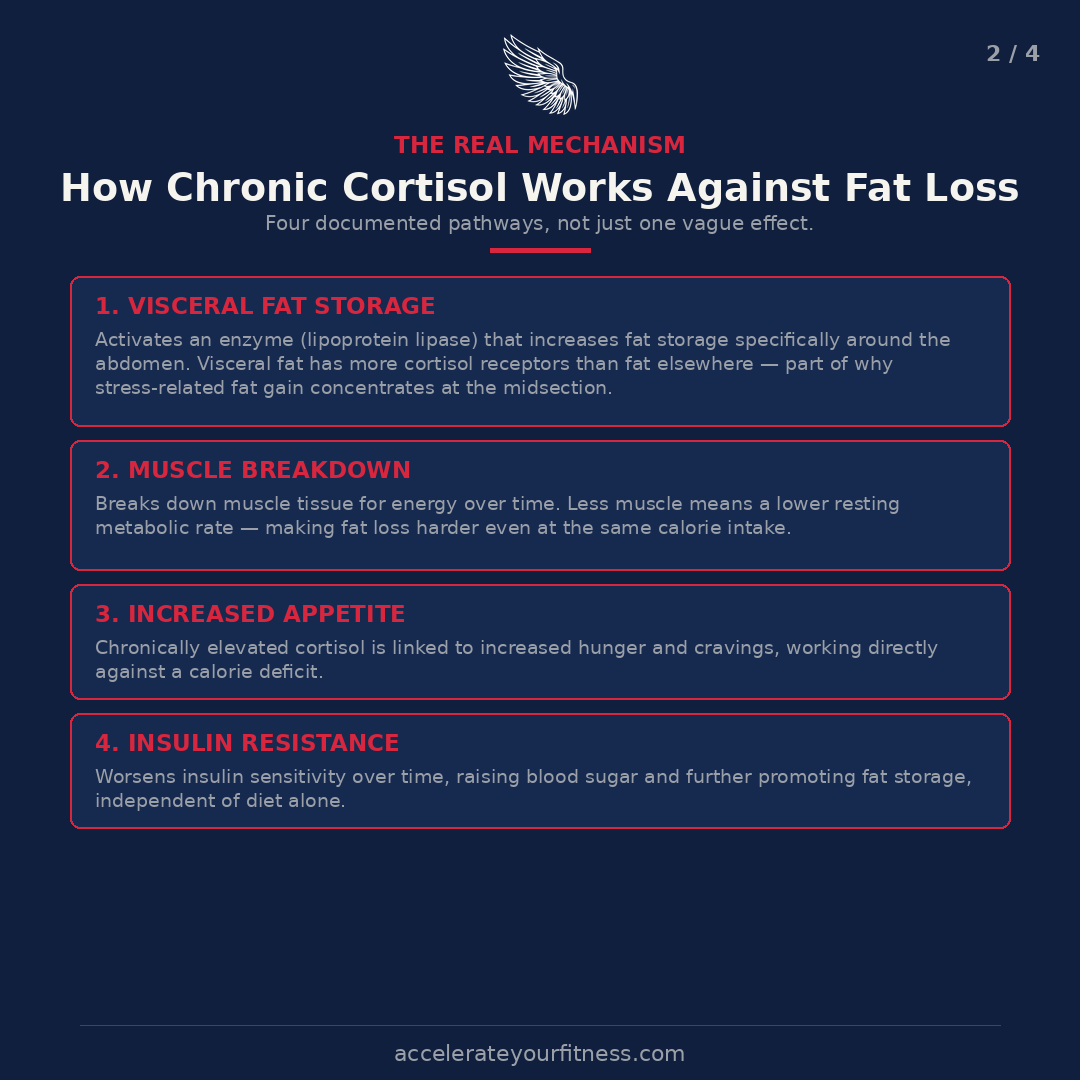
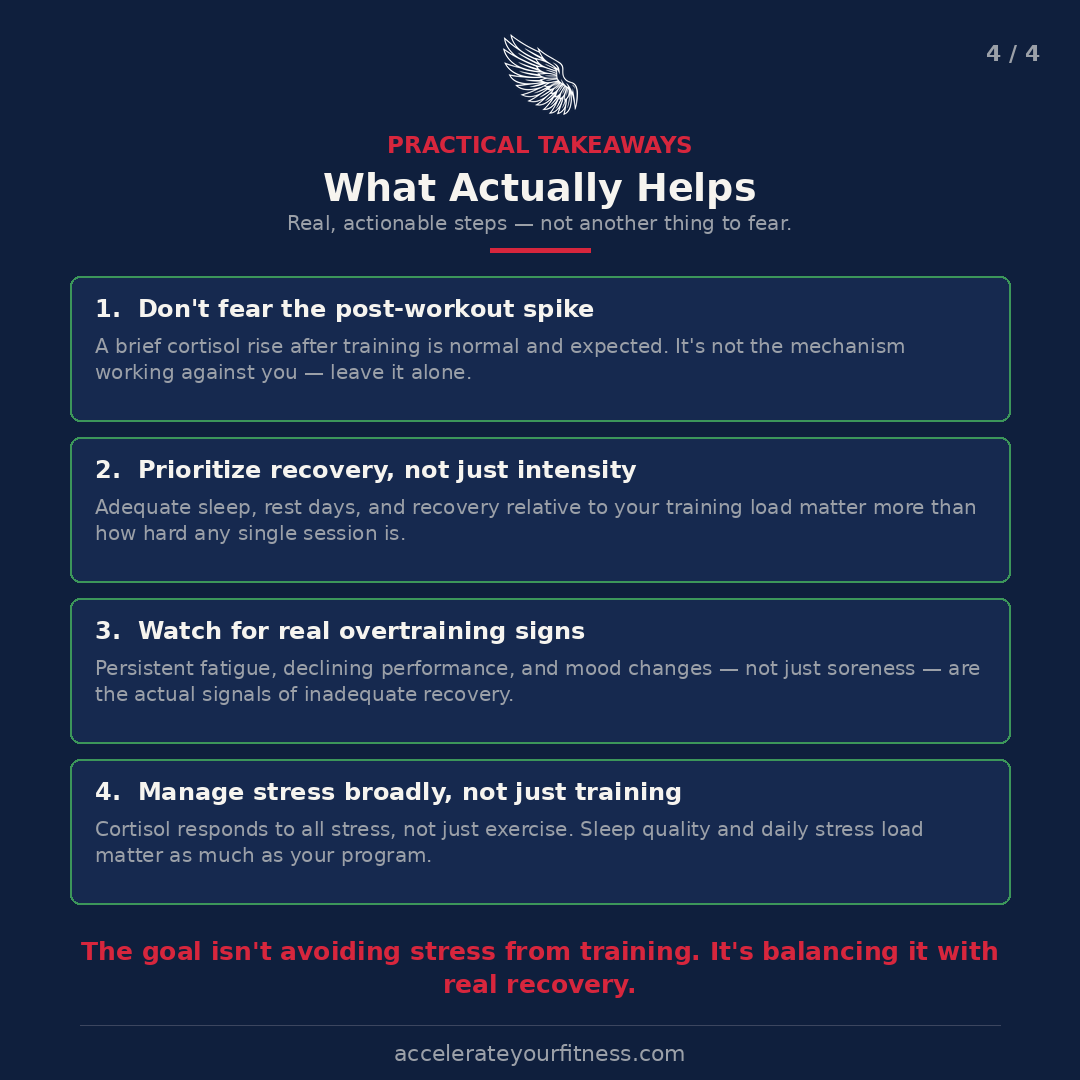
A brief cortisol spike after a workout is normal and healthy. It returns to baseline within about an hour and isn't the mechanism working against fat loss. The real issue is cortisol that stays elevated chronically without enough recovery, which works against fat loss in four documented ways: it promotes visceral fat storage, breaks down muscle (lowering your resting metabolic rate), increases appetite, and worsens insulin sensitivity.
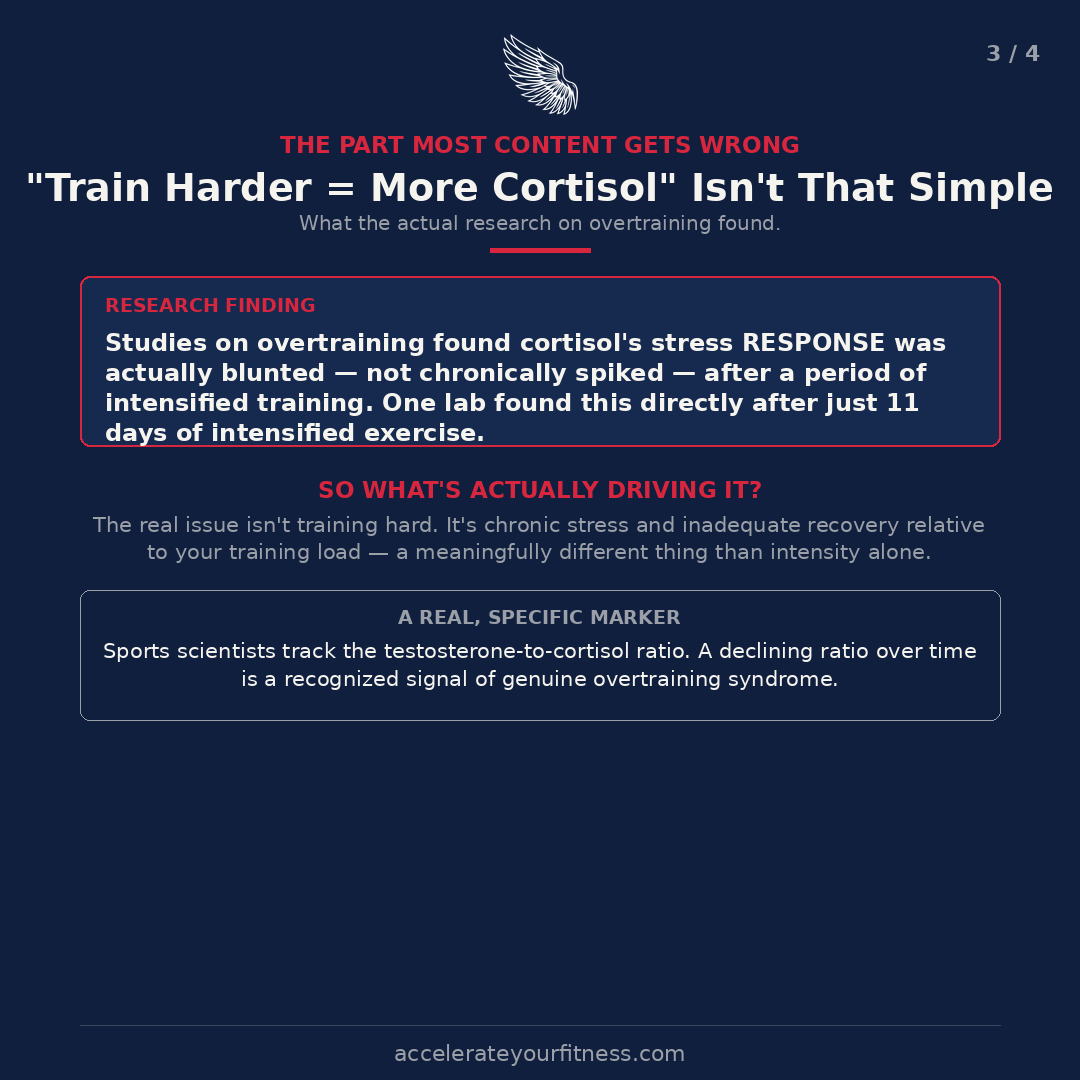
Here's the part most fitness content gets wrong: research on overtraining found that cortisol's stress response was actually blunted, not chronically spiked, after a period of intensified training. One lab saw this after just 11 days of intensified exercise. The real driver isn't training hard. It's chronic stress and inadequate recovery relative to your training load. Sports scientists track the testosterone-to-cortisol ratio, and a declining ratio over time is a recognized signal of overtraining syndrome.
What actually helps: don't fear the post-workout spike, prioritize recovery and sleep, watch for persistent fatigue, declining performance, and mood changes (not just soreness), and manage stress outside the gym too.
How Sleep Affects Your Training
Most of the work of getting stronger happens while you're not training.
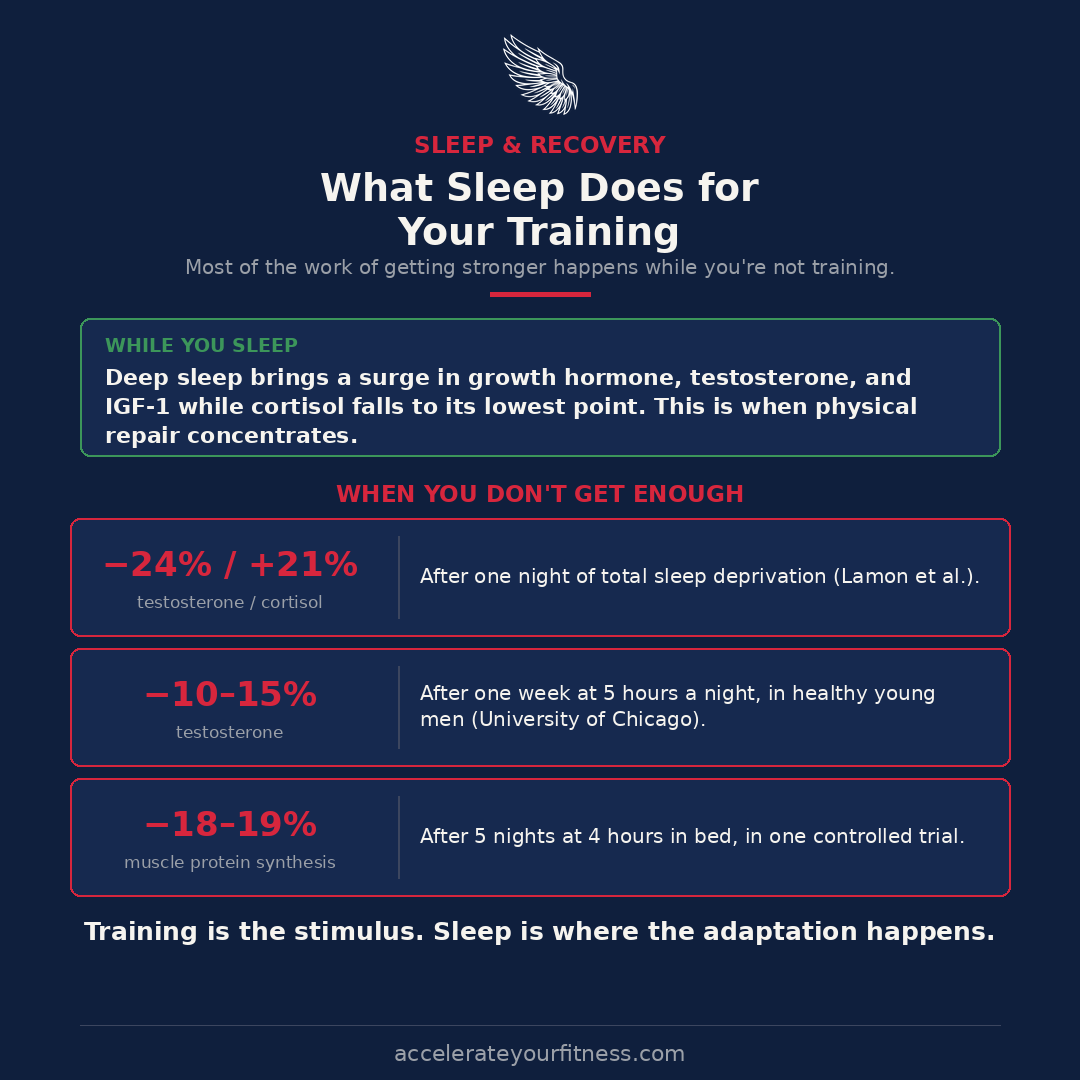
Deep sleep brings a surge in growth hormone, testosterone, and IGF-1 while cortisol falls to its lowest point, and that's when physical repair concentrates. Cut it short and it shows. One night of total sleep deprivation lowered testosterone by about 24% and raised cortisol by about 21% (Lamon et al.). A week at 5 hours a night lowered testosterone 10–15% in healthy young men (University of Chicago). In one controlled trial, 5 nights at 4 hours in bed reduced muscle protein synthesis by roughly 18–19%.
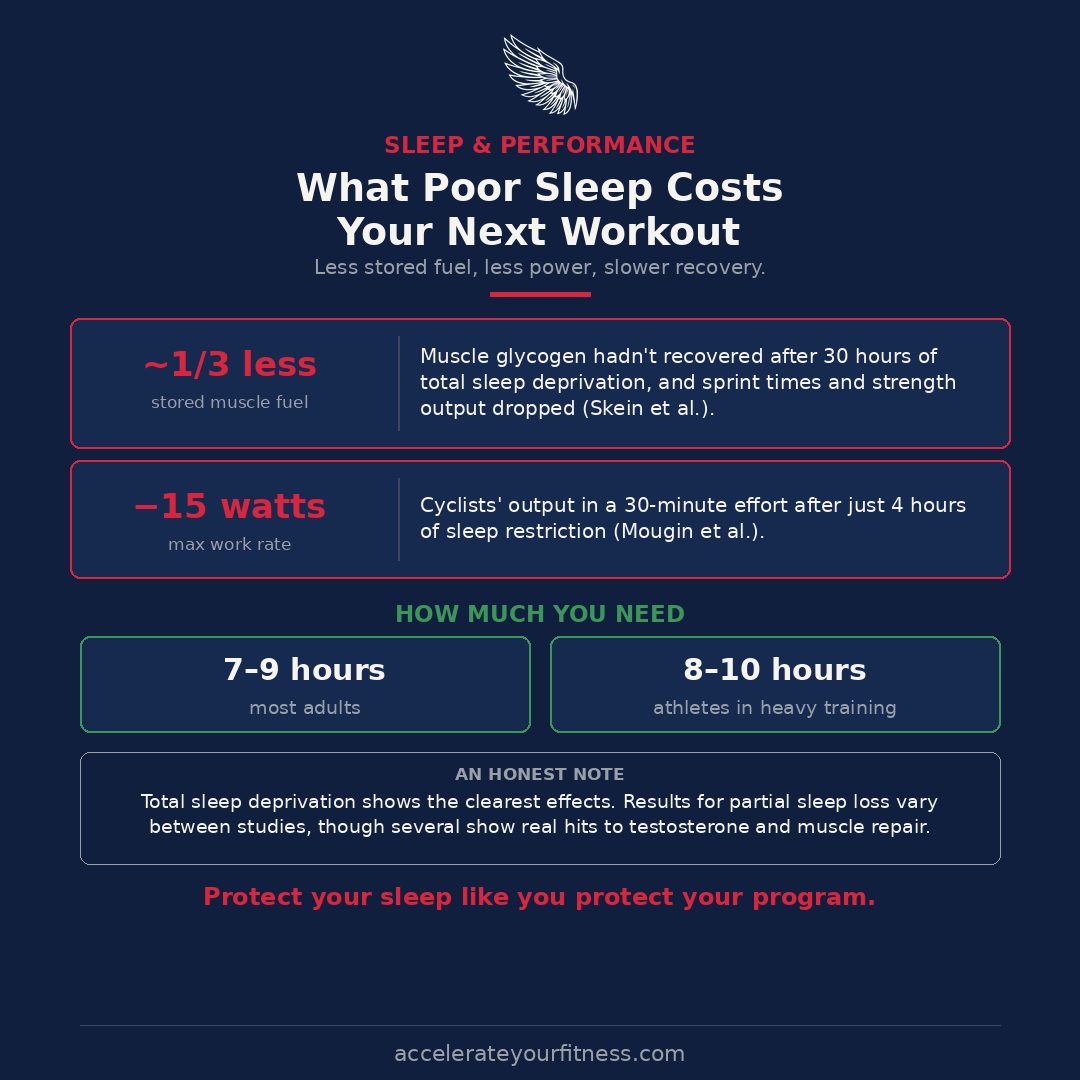
It costs you in the gym too. Cyclists lost about 15 watts of maximum output after just 4 hours of restricted sleep (Mougin et al.), and after 30 hours without sleep, athletes' muscle fuel stores hadn't recovered and sprint times and strength output dropped (Skein et al.). An honest note: total sleep deprivation shows the clearest effects, and results for partial sleep loss vary between studies. Most adults need 7–9 hours, and athletes in heavy training often need 8–10.